

A Spatially Resolved Intracellular Photoproximity Profiling Technology For Mapping And Targeting Protein Interactions In Cancer
SUMMARY
A matched pair of photoproximity probes coupled with quantitative proteomics which enable context-dependent mapping of protein complex topology inside cells including to map MYC interactomes across temporal, spatial and disease-relevant contexts
-
The study of protein-protein interactions and the mapping of protein complex topologies within live cells are central to understanding cellular regulation, disease mechanisms, and the identification of novel therapeutic targets. In the context of cancer biology, the c-MYC transcription factor is a master regulator of cell proliferation and is aberrantly expressed in the majority of human cancers. MYC functions through dynamic and context-dependent interactions with a variety of transcriptional regulatory complexes, making it a critical node in oncogenic signaling networks. However, the transient and spatially restricted nature of these interactions, combined with the pseudo-ordered structure of MYC, presents significant challenges for researchers aiming to elucidate the precise molecular mechanisms underlying MYC-driven oncogenesis and to identify actionable vulnerabilities for therapeutic intervention.
-
Current approaches for mapping protein interactions, such as co-immunoprecipitation (co-IP), proximity labeling (e.g., BioID, APEX), and conventional proteomics, suffer from several limitations that hinder their effectiveness in capturing the dynamic, spatially resolved, and context-specific nature of protein complexes in live cells. Co-IP often fails to detect weak or transient interactions and can be confounded by non-specific binding or loss of spatial information. Proximity labeling techniques, while offering improved coverage, typically lack the spatial and temporal resolution required to distinguish between direct and indirect interactors within complex cellular environments. Additionally, many of these methods require prolonged labeling times or harsh experimental conditions that can perturb native protein complexes, leading to artifacts and reduced biological relevance. As a result, there remains a critical need for technologies that can provide high-resolution, minimally perturbative, and context-dependent mapping of protein interactomes to enable the discovery of novel therapeutic targets, particularly in challenging systems such as MYC-driven cancers.
-
The faculty inventor developed spatially resolved, intracellular photoproximity (siPROX) profiling, a powerful method that combines photochemically tuned, cell-permeable probes with quantitative proteomics to map protein complex topologies and interactomes within live cells. The workflow involves synthesizing specialized probes that covalently label proteins in proximity to a SNAP-tagged protein of interest.This enables high-resolution, context-dependent mapping of protein interactions in live cells with minimal disturbance. Applied to the oncogenic transcription factor MYC, siPROX revealed dynamic interactions with chromatin-associated regulatory complexes, particularly highlighting persistent associations with specific BAF complex members. The method further demonstrated that pharmacological inhibition of BAF complex function—specifically targeting SMARCA2/4 ATPase activity—leads to rapid loss of chromatin-bound MYC, downregulation of MYC-dependent gene expression, and reduced proliferation in MYC-driven cancer models, offering a novel therapeutic strategy.
FIGURE
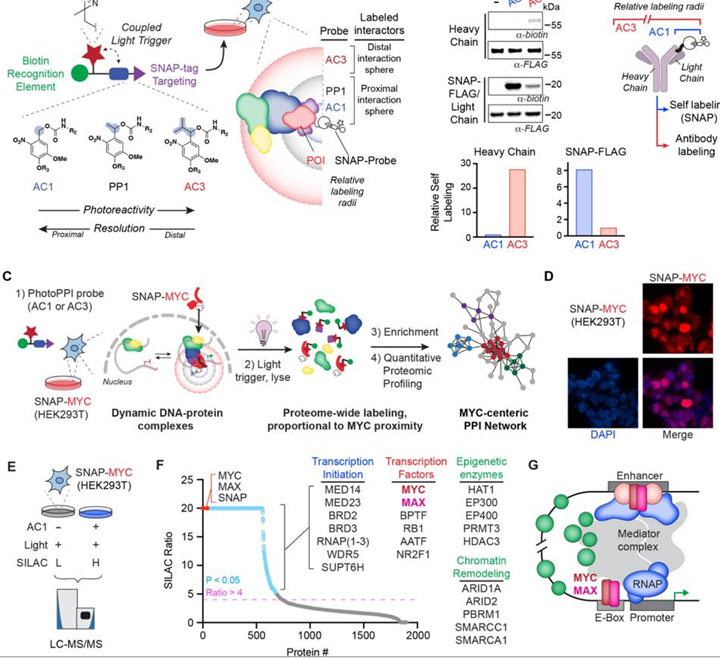
Photochemically tuned AC/AC3 probes enable spatially resolved mapping of protein complexes in vitro and in cells
ADVANTAGES
ADVANTAGES
-
Enables high-resolution, spatially and temporally resolved mapping of protein complex topology and interactomes within live cells
-
Uses photoproximity probes for rapid, minimally perturbative labeling of proteins near a target, improving specificity and coverage over traditional methods
-
Facilitates identification of therapeutically actionable protein interactions, exemplified by discovering the MYC-BAF complex interaction as a cancer vulnerability
-
Supports pharmacological targeting of the MYC-BAF axis to downregulate MYC-dependent gene expression and inhibit cancer cell proliferation
-
Modular and broadly applicable platform for studying any SNAP-tagged protein and its dynamic interactome in diverse biological contexts
-
Combines chemical biology with quantitative proteomics and bioinformatics for comprehensive protein interaction analysis.
APPLICATIONS
-
Oncology drug development
-
Personalized oncology diagnostics
-
High-resolution protein interaction mapping
-
Drug mechanism-of-action studies