

Type I Interferons For Enhancing Chimeric Antigen Receptor T-Cell Efficacy
SUMMARY
Method to enhance CAR T-cell efficacy by incorporating low-dose exogenous IFN-α2 into CD19-directed, CD28-costimulated CAR T cells post-transduction during manufacturing boosting cytolytic molecule expression, cytokine secretion, and cytotoxicity while minimizing apoptosis
The Unmet Need: Enhanced CAR T-cell effector function through modulation of cytokine pathways
- Chimeric antigen receptor (CAR) T-cell therapy represents a significant advancement in treating hematological malignancies, particularly for patients with relapsed/refractory diffuse large B-cell lymphoma (r/r DLBCL). This innovative immunotherapy harnesses a patient's own immune cells to target and eliminate cancer. Despite its transformative potential, a substantial proportion of patients, approximately 60% in the case of r/r DLBCL, do not achieve durable remissions or experience treatment failure, highlighting a critical need to enhance the efficacy and reliability of this therapeutic approach.
-
The primary challenge with current CAR T-cell therapy lies in optimizing the functional characteristics of the manufactured cells to ensure robust and sustained anti-tumor activity in patients. Existing manufacturing protocols often result in variability in the quality and potency of the final CAR T-cell product. This can lead to cells with suboptimal cytolytic capacity, insufficient cytokine secretion, or impaired persistence within the patient's body. Consequently, a significant number of patients fail to respond adequately or relapse, indicating that current approaches do not consistently prime CAR T cells for the sustained, potent responses required to overcome disease progression.
- The faculty inventor developed a method to enhance the antitumor activity of CD19-directed, CD28-costimulated CAR T cells by adding controlled doses of exogenous IFN-α2 during their manufacturing, specifically post-transduction. Research indicated that low-dose IFN-α2 significantly increases the expression of cytolytic molecules like granzyme B and perforin, improves cytokine secretion, and enhances overall cytotoxicity. Crucially, this approach minimizes apoptosis, thereby balancing improved effector function with maintaining cell viability. Both in vitro assays and in vivo xenograft models have demonstrated that this low-strength type I interferon signaling leads to superior CAR T-cell functionality and improved therapeutic outcomes.
-
This approach is differentiated by addressing the significant treatment failure rate of current CAR T-cell therapies, leveraging insights from clinical patient data. Single-cell transcriptomic analysis revealed that complete responders to existing CAR T-cell therapy exhibited stronger IFN-I signaling, inspiring this targeted modulation. Unlike simply adding a cytokine, this method precisely optimizes IFN-I signaling; high doses proved detrimental by inducing apoptosis, whereas a carefully selected low dose enhances effector functions without compromising cell viability or persistence. Furthermore, utilizing an already FDA-approved pharmacophore (IFN-α2) streamlines its potential translation, offering a data-driven, refined strategy to improve CAR T-cell efficacy and patient outcomes.
FIGURE
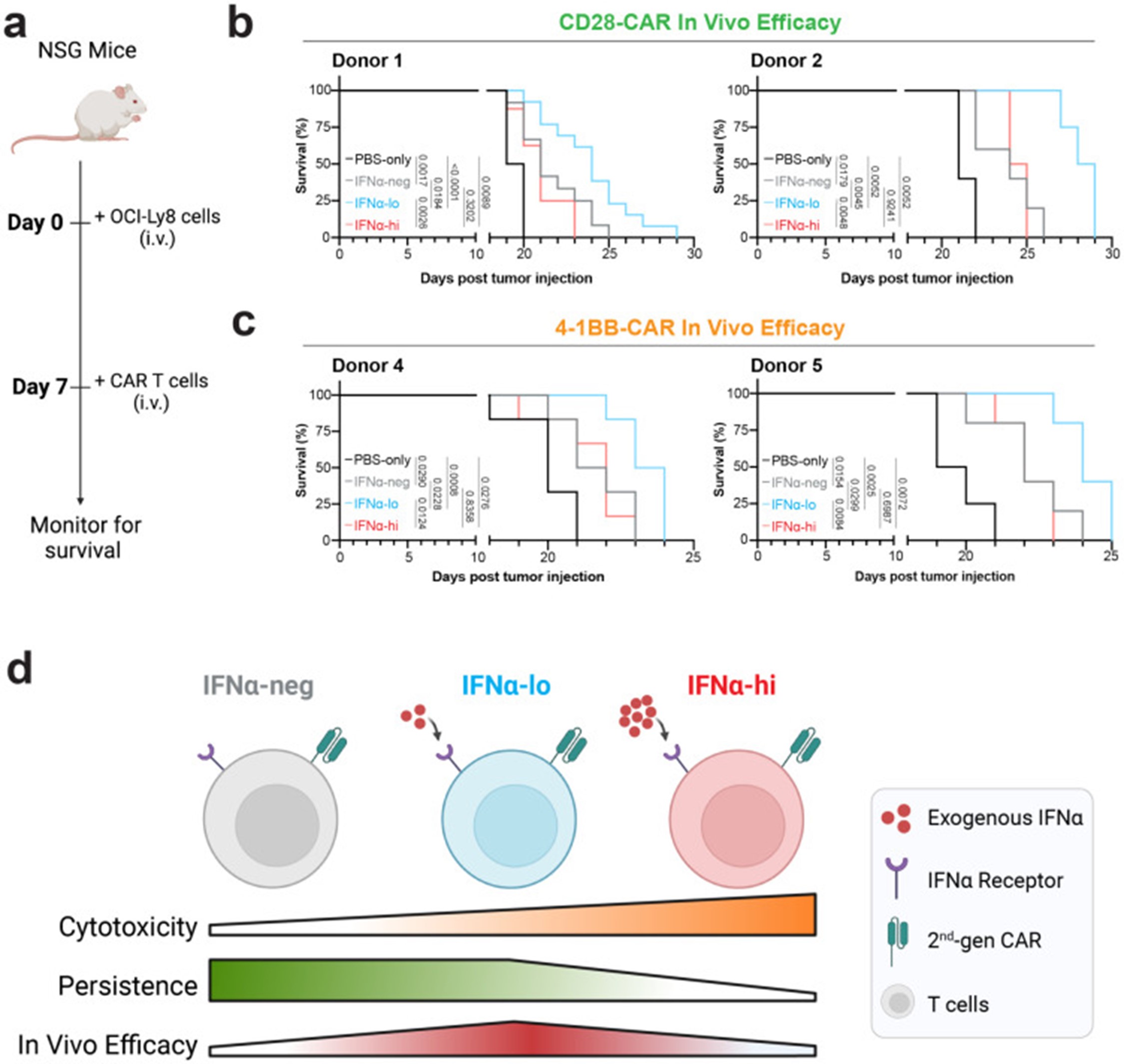
Low-strength IFN-I signaling promotes CAR T-cell treatment efficacy in vivo
ADVANTAGES
ADVANTAGES
-
Enhances CAR T-cell antitumor activity and functionality
-
Improves patient outcomes by increasing CAR T-cell efficacy and persistence
-
Leverages an FDA-approved compound, facilitating clinical translation
APPLICATIONS
-
Enhanced CAR T-cell production
-
Improved CAR T-cell therapy
-
Lymphoma treatment enhancement
-
Cancer immunotherapy advancement
PUBLICATIONS