

Prophylactic Strategy For C. Difficile Infection Prevention
SUMMARY
This technology is a prevention method for those at risk of C. difficile infection using a mutated strain of C. difficile that reduces toxicity and competes with virulent strains, offering a safer alternative to antibiotics and fecal microbiome transplants by colonizing the colon and preventing infections.
- Clostridioides difficile (C. difficile) is a Gram-positive, spore-forming anaerobe that is the leading cause of nosocomial infection in U.S. adults. It is estimated that C. difficile causes 223,900 cases and 12,800 deaths yearly with annual healthcare costs in excess of $1 billion dollars. C. difficile infection (CDI) symptoms range from asymptomatic colonization to mild diarrhea to severe pseudomembranous colitis, which can lead to mortality. Susceptibility to CDIs is associated with gut dysbiosis and the loss of microbiota-mediated colonization resistance.
-
Current approaches to treating C. difficile infections, primarily through antibiotics, pose significant problems. While antibiotics can eliminate C. difficile, they also indiscriminately kill beneficial gut bacteria, further compromising the gut microbiome's integrity. This disruption can make patients more susceptible to recurring infections, including reinfections by C. difficile. Additionally, fecal microbiome transplantation, though effective in restoring gut flora, carries safety concerns due to the potential presence of harmful microorganisms in the donor material. These issues highlight the urgent need for targeted treatments that can mitigate C. difficile infections without adversely affecting the overall gut microbiome.
- The faculty inventor, Eric Pamer, developed a potential vaccine with a clinically isolated C. difficile strain with a mutation in the cdtR gene (binary toxin transcription regulator). This mutant strain seeds in the colon of affected patients and out-competes virulent strains preventing the dominance of harmful C. difficile infections. Additionally, since C. difficile forms spores, this vaccine can be used to effectively colonize the colon at a very low dose providing a targeted and efficient solution without further disrupting the gut microbiome.
FIGURE
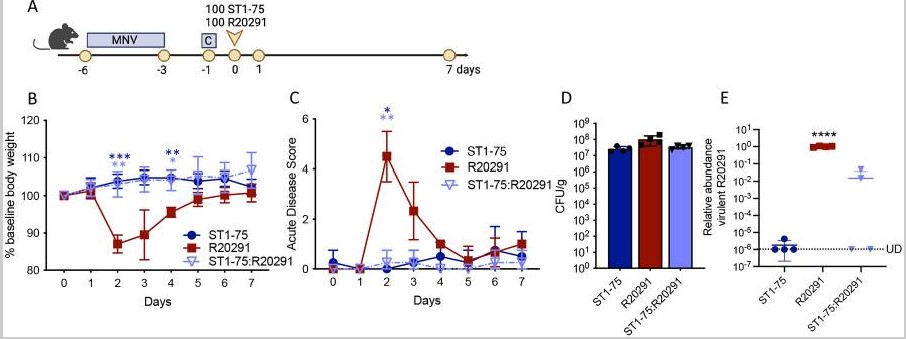
Coinfection of avirulent ST1–75 with a virulent C. difficile strain prevents disease in antibiotic-treated mice.
(A) Schematic of the experimental procedure. Wild-type C57BL/6 mice (n = 4 per group) were treated with Metronidazole, Neomycin and Vancomycin (MNV, 0.25 g/L for each) in drinking water for 3 days, followed by one intraperitoneal injection of Clindamycin (200 mg/mouse), indicated as C in the schematic, 2 days after antibiotic recess. Then, mice were inoculated with 100 R20291 C. difficile spores and 100 ST1–75 C. difficile spores via oral gavage. Daily body weight and acute disease scores were monitored for 7 days post-infection. (B) %Weight loss relative to the baseline of mice infected with indicated strains. (C) Acute disease scores comprising weight loss, body temperature drop, diarrhea, and morbidity of mice infected with indicated strains. (D) Fecal colony-forming units were measured by plating on selective agar on 1 day post-infection. (E) Relative abundance of R20291 in feces from infected mice was determined by measuring wildtype cdtR copies by qPCR on 1 day post infection. UD: Under the limit of detection. Statistical significance was calculated by unpaired t-test and One-way ANOVA, * p < 0.05, ** p < 0.01, *** p < 0.001, **** p < 0.0001. Statistical significance was observed between R20291 to ST1–75 and R20291 to ST1–75:R20291.
ADVANTAGES
ADVANTAGES
- Vaccine to reduce the risks of C. difficile infection
- Safer and cheaper alternative to traditional antibiotics and fecal microbiome transplantation
- Targets C. difficile specifically without disrupting the gut microbiome
APPLICATIONS
- Vaccine against C. difficile
- Method to reduce severity of clinical manifestations of infection by C. difficile