

Probing Cellular Activity Via Charge-Sensitive Quantum Nanoprobes
SUMMARY
Quantum nanoprobe system enables real-time probing of intracellular chemical environments and activity to advance biological and medical diagnostics
The Unmet Need: Novel ways to probe cellular processes and improve biological sensing
- Understanding complex cellular processes in real-time at the single-cell level is crucial for advancements in biology and medical diagnostics. Current methods often lack the necessary sensitivity and specificity to monitor dynamic intracellular changes, such as those related to cellular activity and metabolic states. There is a significant need for non-invasive, highly sensitive tools that can probe the intricate chemical and electrical environments within living cells to gain deeper insights into their function and dysfunction.
-
Existing quantum sensing techniques, particularly those utilizing diamond-based nanoprobes, face substantial challenges. A major issue is the presence of systematic measurement errors, which can lead to misinterpretations of observed phenomena. For instance, shifts in quantum sensor signals within cellular systems have frequently been attributed solely to local temperature variations. However, these shifts can also arise from changes in the local charge environment or surface potentials, leading to inaccurate conclusions about cellular states. Furthermore, many conventional technologies struggle to detect subtle yet critical cellular activities, limiting comprehensive understanding.
- The faculty inventor employed nitrogen-vacancy (NV) centers in diamond nanocrystals to measure local electric field changes, detected as shifts in zero-field splitting (ZFS) via optically detected magnetic resonance (ODMR) spectroscopy. A model incorporating a secondary transverse dipole term predicts that surface potential-induced band bending ionizes nitrogen defects, generating an electric field that causes asymmetric line broadening and contrast changes in the ODMR spectrum. The sensing uses a two-point measurement with a PID control loop for improved temporal resolution. Core-shell particles, with a protective silica layer, are crucial for suppressing optically induced ZFS drifts, enhancing signal stability, and minimizing cellular toxicity, enabling the probing of cellular activity.
-
This quantum sensing approach stands out due to its novel mechanism for real-time single-cell sensing, specifically by incorporating the previously neglected secondary transverse dipole term in its model. This innovation provides a new interpretation for systematic ZFS shifts in cellular systems, attributing them to local chemical environments and cellular activity rather than just temperature. The development of core-shell particles is vital, ensuring stable ZFS measurements and significantly reducing cellular toxicity, which addresses a major challenge in diamond-based nanothermometry. This enables a unique sensing modality that directly links measurable ZFS shifts to cellular processes, offering capabilities difficult to achieve with conventional methods.
FIGURE
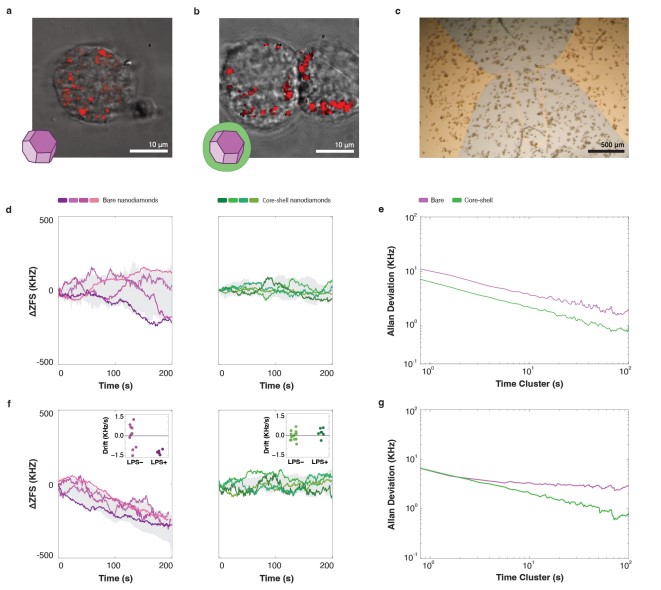
Probing macrophages inflammation with charge sensitive quantum nanoprobes
ADVANTAGES
ADVANTAGES
- Enables novel real-time sensing of cellular activity by detecting local electric field changes, distinct from temperature variations
-
Provides enhanced signal stability and reliability through core-shell particle design, minimizing measurement drifts
-
Reduces cellular toxicity and improves biocompatibility, making the nanoprobes safer for biological applications
-
Offers improved temporal resolution for rapid detection of cellular changes
-
Advances quantum sensing for biological applications by addressing limitations of previous methods and providing new insights into cellular processes
APPLICATIONS
-
Drug efficacy testing
-
Early disease detection
-
Intracellular environment mapping
-
Cellular toxicity assessment
-
Personalized therapy monitoring