

A Novel Antibody Drug Conjugate To Improve Cancer Therapy Efficacy
SUMMARY
A novel antibody-drug conjugate (ADC) with a lactate-responsive linker, enhancing therapeutic specificity by remaining stable in healthy tissues and releasing its therapeutic payload in high lactate tumor environments.
- Lactate is elevated in the tumor microenvironment (produced by cancer cells), but not in surrounding healthy tissue. This concentration difference offers an opportunity to improve targeted drug delivery.
-
ADCs are used to deliver anti-cancer agents directly to tumor sites. As of 2023, 11 FDA-approved ADCs exist. However, they often cause off-target toxicity and suboptimal activity, meaning the field needs more effective, less toxic solutions. Additionally, "on-target toxicity" is an issue, where ADCs affect normal tissue expressing the target antigen.
-
There is an emerging interest in using chemically-responsive linkers to improve drug delivery to tumors while minimizing toxicity. A lactate-responsive linker that stays stable in healthy tissue but cleaves in high lactate tumor environments is a promising approach for ADC optimization.
The proposed solution: Antibody-drug conjugate incorporating a lactate-reacting linker
- The faculty inventor has developed a novel antibody-drug conjugate (ADC) with a lactate-responsive linker, structured as either enzyme-Ab-linker-payload or Ab-enzyme-linker-payload, which targets the lactate-rich tumor environment to enhance therapeutic specificity. This linker remains stable in healthy tissue but cleaves in tumor environments with high lactate levels by detecting products of lactate conversions (e.g., H+ and H2O2). After being triggered by this signal in the TME, the ADC can release its therapeutic payload into the tumor microenvironment. In a mouse model of breast cancer, the lactate-responsive ADC demonstrated greater efficacy and reduced tumor volume compared to a commercially available ADC with the same antibody and payload.
FIGURE
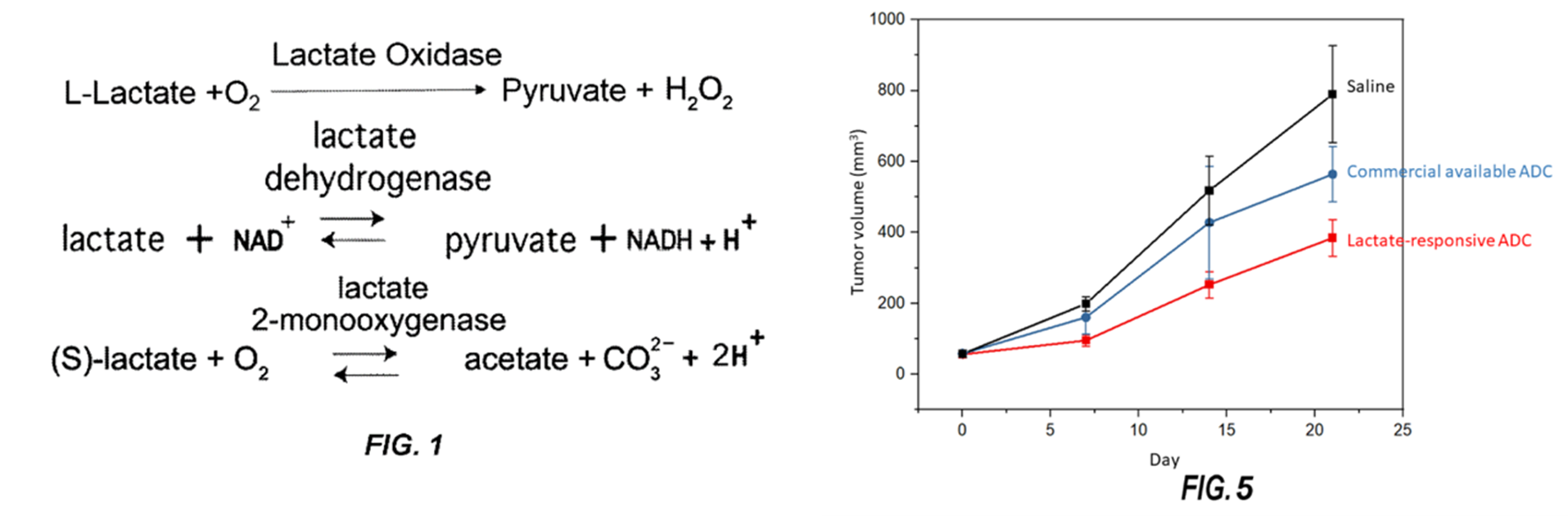
Potential lactate-reacting enzymes that catalyze lactate to stimulate cleavage of the redox or pH-responsive chemical bond (Fig. 1); greater anti-tumor efficacy of lactate-responsive ADC over a commercially available ADC (Fig. 5).
ADVANTAGES
ADVANTAGES
-
Leverages tumor-specific microenvironment (lactate concentration) to improve targeting of ADC
-
Applicability to solid and non-solid tumor cancer treatment markets
-
Modular nature of technology
-
Ability of the linker’s reactive functional groups to be covalently conjugated to one or more payloads, and the other side of the linker to be covalently conjugated to one or more antibodies
APPLICATIONS
-
Novel ADC composition including a lactate-reacting linker to improve cancer drug efficacy
-
Use the lactate-reacting linker for diagnostic applications in high lactate microenvironments of clinical concern
- Demonstrated therapeutic efficacy in an in vivo solid tumor mouse model.