

OSCA: A System For Efficient Construction Of Adenovirus Vectors
SUMMARY
- Adenoviruses (Ad) are a non-enveloped linear double-stranded DNA viruses with over 50 serotypes identified in humans. They have received significant attention as an in vitro and in vivo gene delivery vehicle due to their well-defined virology/biology, viral genetic stability, high gene transduction efficiency, and ability to be produced in a large scale. Ad-vectors are used as delivery vehicles to express transgenes, to express siRNAs for gene silencing, and/or CRISPR/Cas and designer nucleases systems for genome editing.
- Even though Ad-vectors offer many advantages as compared with other viral vectors used for gene delivery and they have been widely employed, the initial generation of a given Ad-vector is a technically challenging and time-consuming process, making development of a simpler and more efficient construction process desirable.
- Inventors have evaluated a technique to simplify the Ad-vector making process by developing a one-step construction of adenovirus (OSCA) system using Gibson DNA Assembly (GDA) technology. The developed OSCA system uses the Ad recipient vectors containing the bacterial suicide gene ccdB flanked with two 20-bp unique sequences; MOS1 and MOS2, which serve as universal sites for GDA reactions at the Ad genome E1 region.
- Proof-of-principle experiments indicated that GDA reactions were highly efficient producing >95% positive colonies, and that resultant recombinant Ad plasmids were effectively packaged into adenoviruses within 7 days in 293ptP cells. Ad-vector mediated expression of mouse BMP9 was also shown to efficiently induce osteogenic differentiation of mesenchymal stem cells.
FIGURE
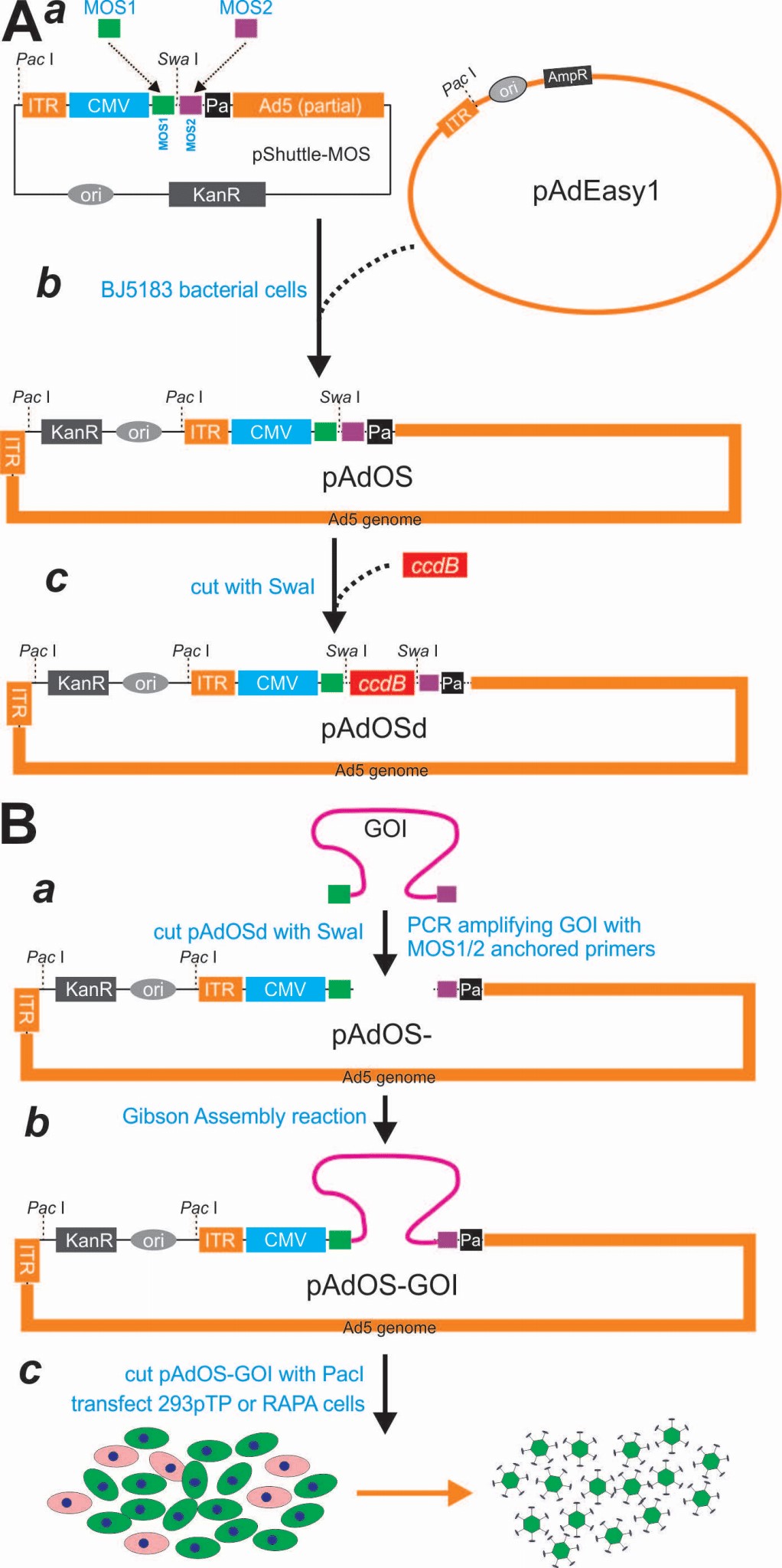
OSCA System using Gibson DNA Assembly Technology
ADVANTAGES
ADVANTAGES
- Developed OSCA system streamlines/simplifies the Ad-vector making process
- Technology facilitates Ad-based applications for use in basic, translational, and clinical research
APPLICATIONS
- Gene therapy
- Vaccine development