

Next-Generation Activity-Based Radiotracer For In Vivo Positron Emission Tomography (PET) Imaging And Therapy
SUMMARY
-
Cancer cells show alterations in metabolism that support malignancy and disease progression. Prominent among these metabolic changes is elevations in neutral ether lipids (NELs).
-
The lipid hydrolase neutral cholesterol ester hydrolase 1 (NCEH1), also known as AADACL1 or KIAA1363, has been shown to control the production of NELs in cancer cells.
-
The consistent and dramatic upregulation of NCEH1 activity in multiple aggressive cancer cells suggests it is involved in or associated with general processes of tumor progression and that its activity may serve as a marker for malignant potential.
-
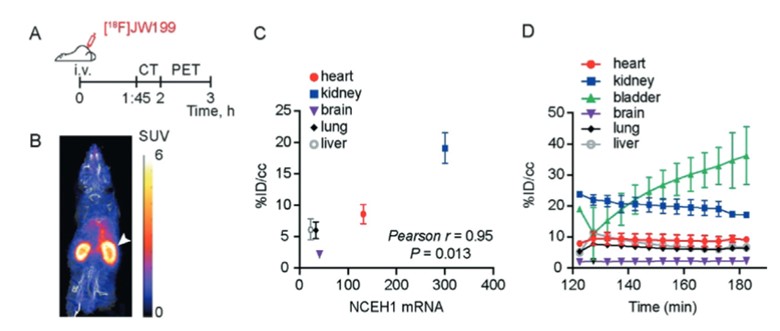
The faculty inventor has developed novel fluorinated covalent small molecules targeting NCEH1 for in vivo PET imaging and therapy.
-
The technology combines the selective targeting capacity of covalent activity-based probes with the imaging power of PET to create an activity-based radiotracer targeting NCEH1.
FIGURE
ADVANTAGES
ADVANTAGES
-
Selective targeting capacity of covalent activity-based probes
-
Tumor visualization using PET
-
Capability to disclose malignant potential of targeted tumor tissue
APPLICATIONS
-
Research tool for visualization of NCEH1 in tumor microenvironment
-
Diagnostic for in vivo tumor imaging of cancer-associated enzymes
-
Drug development of selective NCEH1 inhibitor for cancer treatment
- Potent and specific target engagement in cells and in vivo, enabling direct visualization of active NCEH1 in the microenvironment of aggressive triple-negative breast cancer xenografts.
PUBLICATIONS
- Chang JW, Bhuiyan M, Tsai HM, Zhang HJ, Li G, Fathi S, McCutcheon DC, Leoni L, Freifelder R, Chen CT, Moellering RE. In Vivo Imaging of the Tumor-Associated Enzyme NCEH1 with a Covalent PET Probe. Angew Chem Int Ed Engl. 2020 Aug 24;59(35):15161-15165. doi: 10.1002/anie.202004762. Epub 2020 Jun 15. PMID: 32415874; PMCID: PMC7748380.