

Engineered Multipurpose Antibody Module Platform
SUMMARY
-
Traditionally, antibodies were produced using animal immunization methodologies. While this approach is still in broad use, recombinant display technologies have now assumed the leading role in producing antibody‐based affinity reagents.
-
A particularly powerful aspect of these engineered reagents is that other modules having myriad functions can be attached to them either chemically or through molecular fusions. However, these processes can be cumbersome and do not lend themselves to high throughput applications.
-
Consequently, the faculty inventor developed a platform that can introduce multiple functionalities into a class of Fab‐based affinity reagents in a “plug and play” fashion. This platform exploits the ultra‐tight binding interaction between affinity matured variants of a Fab scaffold (FabS) and a domain of an immunoglobulin binding protein, protein G (GA1) that facilitates Fabs to be attached to a wide variety of molecular modules in a facile way.
-
Newly engineered protein G variants and Fab scaffolds represent a 500-fold increase in binding affinity compared to previous-generation technology.
ADVANTAGES
ADVANTAGES
- Fab fragments can be attached together in a plug and play fashion to produce molecular entities having multi‐valency and multi‐specific properties.
- Eliminates the need to design and construct bi‐specific and or multivalent for each individual set of targets.
- Fabs can be “clicked” on to engineered Protein‐G domain(s) that itself can be fused to other molecular modules.
FIGURE
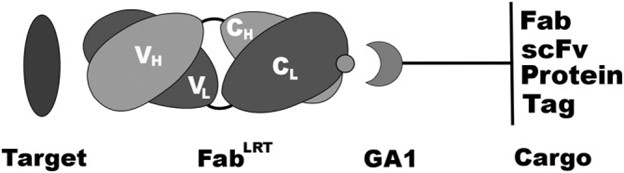
Basic Fab–GA1 construct. Fab can be coupled to a variety of GA1 fusions. The fusions can contain another Fab or scFv to generate a bi‐specific assemblage or another protein or protein fragment. Tags or chemical moieties can to attach to GA1 to further functionalize the fusion
APPLICATIONS
-
The protein G/Fab scaffolds allows for easy attachment to other molecules, which can then be used as therapeutics.
-
High throughput campaign to profile Bi-specific T-cell Engager (BiTE) efficiencies targeting many different cancer specific cell surface antigens.
-
By using a tandem phage display approach new sets of distinct high affinity Fab‐GA1 interactions can be engineered, thus expanding the distinct specificity of the fusion modules beyond bispecific to tri‐specific or tetra‐specific.