

PMO-Based RNA-Degrading Chimeras For Targeted Degradation Of α-Synuclein mRNA In Neurodegenerative Diseases
SUMMARY
Phosphorodiamidate morpholino oligomer (PMO)-based RNA-degrading chimeras reduce α-synuclein protein by degrading its messenger RNA preventing protein aggregation and propagation associated with neurodegenerative diseases.
-
Neurodegenerative diseases such as Parkinson’s disease, Lewy body dementia, and multiple system atrophy are characterized by the abnormal accumulation and aggregation of α-synuclein protein within neurons. These disorders, collectively known as α-synucleinopathies, have a profound impact on cognitive and motor function, leading to progressive disability and significant healthcare burdens. Genetic studies have shown that increased dosage or expression of the SNCA gene, which encodes α-synuclein, is directly linked to the onset and severity of these diseases. As a result, reducing α-synuclein levels has become a central therapeutic goal. However, the intracellular and aggregation-prone nature of α-synuclein, along with its involvement in essential cellular processes, makes it a challenging target for conventional drug development.
-
Current approaches to lowering α-synuclein levels or mitigating its toxic effects face several significant limitations. Traditional small molecule drugs and immunotherapies often struggle to access intracellular α-synuclein aggregates or selectively target the protein without affecting its normal physiological functions. Antisense oligonucleotides and RNA interference strategies, while capable of reducing SNCA mRNA, are frequently hampered by issues such as poor stability, susceptibility to nuclease degradation, off-target effects, and inefficient delivery to neurons. Additionally, many therapies focus on clearing existing protein aggregates rather than preventing their formation, which may not address the root cause of disease progression. These challenges underscore the need for more effective, specific, and durable strategies to reduce α-synuclein production at the molecular level.
-
The faculty inventor developed a therapeutic platform that utilizes phosphorodiamidate morpholino oligomer (PMO)-based RNA-degrading chimeras (RDCs) to selectively degrade the messenger RNA (mRNA) encoding α-synuclein, a protein implicated in neurodegenerative diseases. Each RDC is composed of two main parts: a highly specific, nuclease-resistant PMO that binds to the 5’-untranslated region of the SNCA mRNA, and a synthetic recruiter ligand (RLR). When the PMO binds to its target mRNA, the RLR recruits the endogenous ribonuclease RNase L, which then catalytically cleaves and degrades the SNCA mRNA. This process reduces the production of α-synuclein protein, thereby preventing its aggregation and the propagation of neurodegenerative pathology. The technology has demonstrated efficacy in both humanized mouse neurons and human iPSC-derived neurons, showing significant reductions in α-synuclein levels, inhibition of pathological aggregation, and neuroprotection against toxic fibril-induced cell death.
-
What differentiates this technology is its unique combination of molecular precision, stability, and a novel mechanism of action. Unlike traditional antisense or RNA interference approaches, the PMO backbone is charge-neutral and highly resistant to nucleases, resulting in enhanced stability, reduced off-target effects, and low immunogenicity. The use of a synthetic RLR (D1) enables the recruitment of RNase L, activating a catalytic RNA degradation pathway that is independent of RNase H, which is commonly exploited by other antisense technologies. This upstream intervention at the mRNA level addresses the root cause of α-synuclein-driven disease rather than attempting to clear existing protein aggregates, which are notoriously difficult to target due to their structural heterogeneity and intracellular localization. Furthermore, the platform’s efficacy has been validated in models using patient-derived α-synuclein fibrils and human neuronal systems, underscoring its translational potential and relevance to human disease. The modular design, superior specificity, and mechanistic novelty position this technology as a promising new therapeutic approach for α-synucleinopathies.
FIGURE
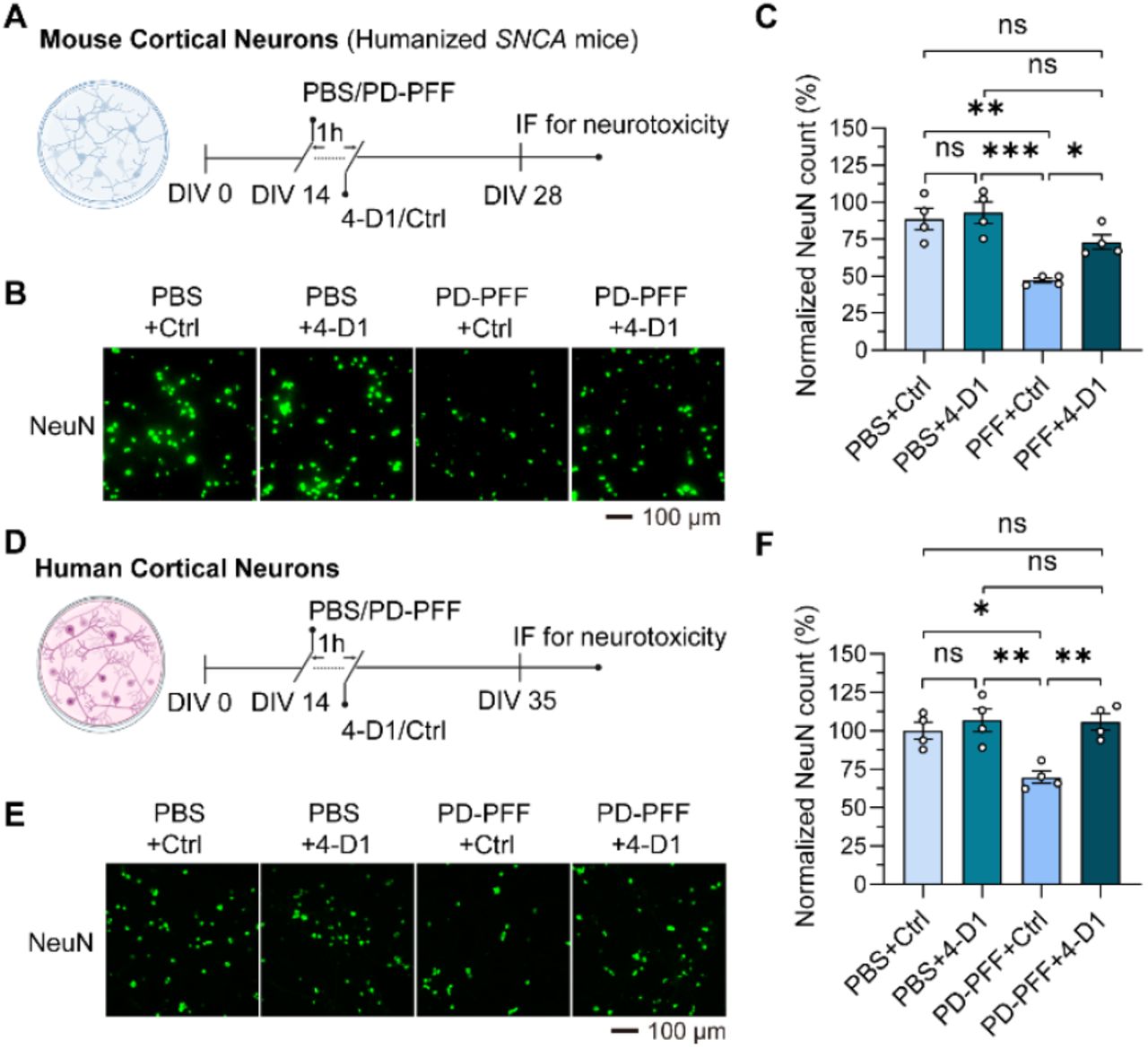
4-D1 alleviated PD-PFF-induced neurotoxicity in humanized SNCA neurons and human neurons.
(A) Schematic of the experiment design of 4-D1 or unconjugated PMO4 (Ctrl) treatment in primary cortical neurons derived from humanized SNCA mice. (B, C) Neurotoxicity assessment with anti-NeuN immunostaining and quantification in primary cultured neurons with 10 μg/mL amplified PD-PFF (n = 4). scale bar, 100 µm. (D) Schematic of the experiment design of 4-D1 or control treatment in human cortical neurons. (E, F) Neurotoxicity assessment with anti-NeuN immunostaining and quantification in primary cultured neurons with 10 μg/mL amplified PD-PFF (n = 4). The statistical significance was evaluated via one-way ANOVA with Tukey’s multiple comparisons test (ns, p > 0.05, *p < 0.05, **p < 0.01, ***p < 0.001).
ADVANTAGES
ADVANTAGES
-
Selective degradation of α-synuclein (SNCA) mRNA reduces pathogenic protein production at the source
-
Utilizes a novel RNase L-dependent mechanism distinct from traditional RNase H antisense approaches
-
Phosphorodiamidate morpholino oligomer (PMO) chemistry offers high stability, low toxicity, and strong target specificity
-
Demonstrates neuroprotection by rescuing neurons from α-synuclein fibril-induced toxicity
-
Potentially overcomes limitations of existing protein-targeted therapies by intervening upstream at the mRNA level
APPLICATIONS
-
Parkinson's disease therapeutics
-
Lewy body dementia treatment
-
Multiple system atrophy therapy
-
Neuroprotective drug development
PUBLICATIONS
- Demonstrated efficacy in both humanized mouse neurons and human iPSC-derived neurons