

A Programmable Translational Activator Platform For Restoring Endogenous Protein Expression In Haploinsufficiency Disorders
SUMMARY
The CIRTS-4GT3 platform is a compact, programmable system that uses guide RNAs and human protein domains to boost production of specific proteins in cells, offering a safe and targeted therapy for genetic disorders caused by insufficient protein levels
- Haploinsufficiency disorders, such as Dravet syndrome, occur when a single functional gene copy cannot produce enough protein for normal cellular function. This deficit leads to severe consequences, including developmental delays and life-threatening epilepsies. Consequently, the field of RNA therapeutics focuses on modulating gene expression to restore normal protein levels. A successful solution must be highly specific, enhancing protein production only in appropriate cell types without disrupting overall cellular homeostasis.
-
Current therapeutic approaches face substantial limitations in addressing these needs. Traditional gene supplementation is frequently hindered by the physical size constraints of viral delivery vectors, such as adeno-associated viruses (AAVs), making it impossible to deliver large therapeutic genes. While microbial-derived CRISPR systems offer programmable targeting, their bacterial origins provoke strong immunogenic responses in humans, risking immune rejection. Furthermore, these microbial proteins are often too large to be efficiently packaged into a single viral vector. Existing methods also struggle with off-target effects and unpredictable expression, which can cause dangerous overexpression or permanent genomic alterations, limiting their clinical viability.
- The faculty inventor developed a CRISPR-Cas-inspired RNA-targeting system (CIRTS) platform that is a programmable, guide RNA-dependent RNA-targeting system designed to function as a highly efficient translational activator. Constructed from human protein domains, this compact fusion protein utilizes a guide RNA to direct a truncated human eIF4GI effector domain to the untranslated regions of a specific target mRNA. Once localized, the effector domain actively recruits eukaryotic initiation factors to facilitate ribosome assembly. This targeted mechanism significantly increases the translation of endogenous mRNAs into functional proteins without altering the underlying mRNA levels.
-
What sets this technology apart is its unique composition and compact size, which overcome major limitations of traditional gene therapies. Because it is engineered entirely from human-derived proteins, the platform minimizes the risk of immunogenicity commonly associated with microbial-derived systems like CRISPR. Furthermore, at just 601 amino acids, the construct is small enough to be easily packaged into a single adeno-associated virus vector for efficient therapeutic delivery. Its mechanism of upregulating existing mRNA ensures that therapeutic effects are safely restricted to cells already expressing the target gene, providing a highly specific, programmable solution for treating haploinsufficiency disorders.
FIGURE
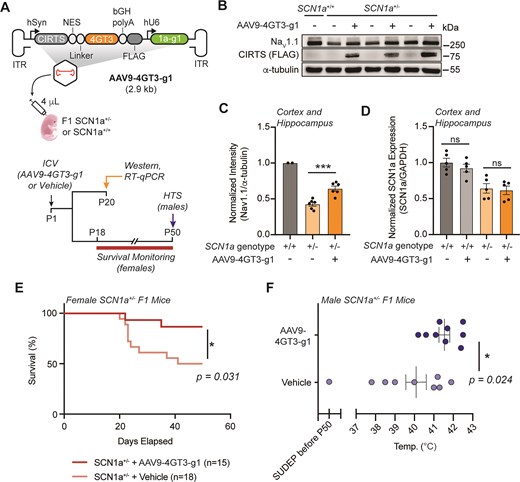
CIRTS-4GT3 improves phenotype in a Dravet syndrome mouse model
ADVANTAGES
ADVANTAGES
- Compact size for efficient delivery
-
Reduced immunogenicity
-
High specificity and safety
-
Programmable versatility
-
Potent therapeutic efficacy
APPLICATIONS
-
AAV-delivered neurological disease treatments
-
Haploinsufficiency disorder gene therapy
-
Targeted protein upregulation therapeutics
-
Programmable mRNA translation research tool
PUBLICATIONS