

SCALES: A System For Predicting Interaction And Function In Bacteria Using Co-Variation
SUMMARY
- The current understanding of how proteins interact to create collective functional groups (e.g., complexes, pathways, meta-pathways) is incomplete and difficult to elucidate. Therefore, the current methods used to characterize/identify the hierarchy of proteins in biology are based on an understanding of only a minimal number of cases/examples.
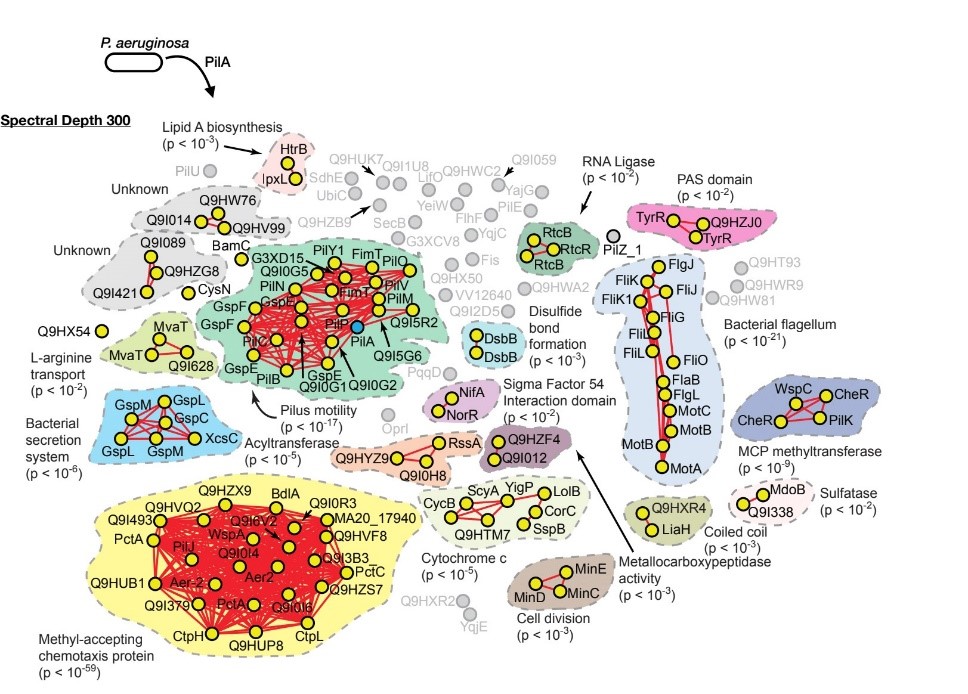
- Inventors at the University of Chicago have developed a technique to derive the emergent organization/nature of bacterial biology using a data-driven and unbiased procedure to analyze protein co-variations across a broad diversity of species using spectral decomposition. The technique, called Spectral Correlation Analysis of Layered Evolutionary Signals (SCALES), provides a framework of biological organization that can be derived from statistical analysis of spectrally decomposed genomic features/variations across a diversity of bacteria. This method results in a data-driven map based on evolutionary information that can be used to predict a hierarchy of protein interactions on a local and global scale which correspond to a hierarchy of biological functions that describe the emergence of complex cellular behaviors.
- SCALES technology was evaluated in the laboratory by focusing on protein co-variations within the kingdom of Bacteria. The approach was used to predict and experimentally evaluate previously unrecognized effectors of motility on two, distinct organisms to show how SCALES can be used as a catalyst for biological discovery. Experimental tests identified novel effectors of swimming and twitch motility in Bacillus subtilis and Pseudomonas aeruginosa, respectively.
- The developed platform as evaluated through laboratory testing demonstrated in two distinct cases how the SCALES method can be used to derive/infer a hierarchy of statistical interactions between proteins reflecting biological functions across different bacterial organisms which enable a better understanding of relevant phenotypes.
FIGURE
ADVANTAGES
ADVANTAGES
- Efficient decoder for extracting biological information from a high-dimensional dataset
- Unbiased technique, not tied to a previous understanding of biological organization
APPLICATIONS
- Accurate prediction of the hierarchy of protein interactions on a local and global scale
- Use of evolutionary data to forecast complex cellular/biological behaviors
- Prediction of how a bacteria will evolve