

Nanomaterial Based Intracellular Drug Delivery Of Therapeutic Peptides
SUMMARY
- Intracellular delivery involves introduction of small biomolecules, nucleic acids, proteins, synthetic nanomaterials and drugs into the cell.
- There is a lot of focus on targeted intracellular delivery for improved therapy of cancer and intracellular infections. Intracellular delivery of various drugs can sharply increase the efficiency of various treatment protocols.
- The inventors have developed polymersome nanoparticles to deliver cargo such as stapled peptides.
- The proof of concept particle is a CD19 Fab linked to the polymersome through a cysteine linker and the stapled peptides (SAH-MS1-18) are enveloped by the polymer.
FIGURE
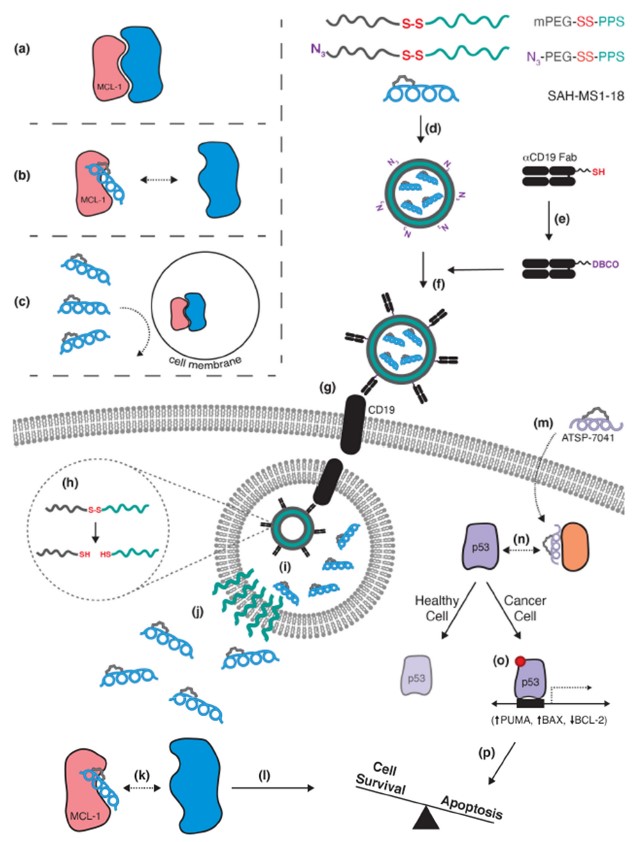
A schematic of CD19-targeted polymersomes deliver SAH-MS1-18 into the cytoplasm of human diffuse large B-cell lymphoma (DLBCL) cells to reactivate cell death and synergize with p53-reactivation. (a) Cancer cells rely on PPIs for inhibition of apoptosis (e.g. MCL-1 sequesters pro-apoptotic proteins). (b) Therapeutic stapled peptides (e.g. SAH-MS1-18) can potently and specifically block a disease-driving PPI. (c) Cellular uptake is a major obstacle to the clinical translation of therapeutic stapled peptides. (d) Stapled peptides are stably encapsulated in PEG-SS-PPS polymersomes. (e) Recombinant αCD19 Fabs are functionalized with a site-specific click chemistry handle. (f) The polymersomes are decorated with αCD19 Fabs and the targeted polymersomes (αCD19-PSOMs) purified. (g) αCD19-PSOMs bind CD19 on DLBCL cells and initiate endocytosis. (h) In the relatively reducing endosome, the disulfide of PEG-SSPPS is reduced. (i) Polymersomes are disrupted and release their cargo. (j) The hydrophobic PPS block facilitates endosomal escape. (k) SAH-MS1-18 binds MCL-1 in the cytoplasm to release pro-apoptotic proteins and (l) reactivate apoptosis if the cell is sufficiently primed to die. (m) Systemic treatment with the p53-reactivating stapled peptide ATSP-7041 (n) inhibits p53's inhibitory binding partners. (o) In cancer cells, phosphorylated/activated p53 translocates to the nucleus to upregulate transcription of pro-apoptotic proteins (e.g. PUMA, 25 BAX) and downregulate transcription of anti-apoptotic proteins (e.g. BCL-2). (p) p53 transcriptional changes sensitize DLBCL to cell death by MCL-1 inhibition.
ADVANTAGES
ADVANTAGES
- The approach allows an efficient delivery of biologic therapeutics such as stapled peptides using nanomaterials since peptides typically are not cell permeable.
- The lower density of the targeting Fab facilitates better delivery.
- The CD19-targeted polymersomes greatly improved the uptake and endosomal escape of therapeutic peptides, amplifying their therapeutic effects by orders of magnitude.
APPLICATIONS
- The potential applications lie in more efficient intracellular drug delivery of stapled peptides for treatment of cancer.
- This technology improves upon prior PEG-SS-PPS polymersomes by targeting them to specific cell surface receptors for targeted delivery, rather than uptake through non-specific endocytosis/phagocytosis.