

Automated Microfluidic Platform For High-Throughput 3D Cell Culture, Dynamic Stimulation, And Single-Cell Analysis
SUMMARY
Automated microfluidic platform enabling high-throughput, precise 3D cell and organoid culture, drug screening, and single-cell analysis, allowing real-time monitoring and dynamic control of cellular environments for advanced research in cancer, stem cells, and personalized medicine.
- Three-dimensional (3D) cell culture and organoid technologies have become increasingly important in biomedical research, particularly in cancer biology, drug discovery, and regenerative medicine. Traditional two-dimensional (2D) cell cultures, while convenient and widely used, fail to replicate the complex architecture, cellular heterogeneity, and microenvironmental cues present in living tissues. Organoids—miniaturized, self-organizing 3D tissue constructs derived from stem cells or primary tissues—offer a more physiologically relevant model, capturing key aspects of tissue structure and function.
-
Despite their promise, current approaches to 3D organoid culture and analysis face significant limitations. Manual handling of organoids is labor-intensive, prone to variability, and restricts throughput, making it challenging to perform large-scale drug screening or systematically study cellular responses to dynamic environmental changes. Conventional culture methods often lack precise control over the delivery of nutrients, drugs, or signaling molecules, and real-time monitoring of organoid development is cumbersome or infeasible. Furthermore, harvesting organoids for downstream analysis can be disruptive and inefficient. These challenges hinder the reproducibility, scalability, and interpretability of organoid-based assays, limiting their utility in both basic research and translational applications such as personalized medicine and high-throughput drug screening.
- The faculty inventor developed an advanced automated microfluidic platform designed to revolutionize 3D cell culture, organoid modeling, and high-throughput drug screening. The core of the system is a two-layer polydimethylsiloxane (PDMS) device featuring an array of wells, each serving as a miniature culture chamber for organoids embedded in hydrogels. The bottom PDMS layer, containing the wells, is bonded to a glass slide, while the top PDMS layer houses fluidic channels that can be reversibly sealed above the wells. An automated control program, operated through a separate microfluidic control chip and a MATLAB graphical user interface, precisely directs the flow of media, drugs, or staining agents to specific subsets of wells, enabling parallel experimentation with varied conditions. Integrated 3D phase contrast and fluorescence deconvolution microscopy allows for real-time monitoring of organoid development and cellular responses, and the removable top layer facilitates easy harvesting of organoids for downstream analysis.
FIGURE
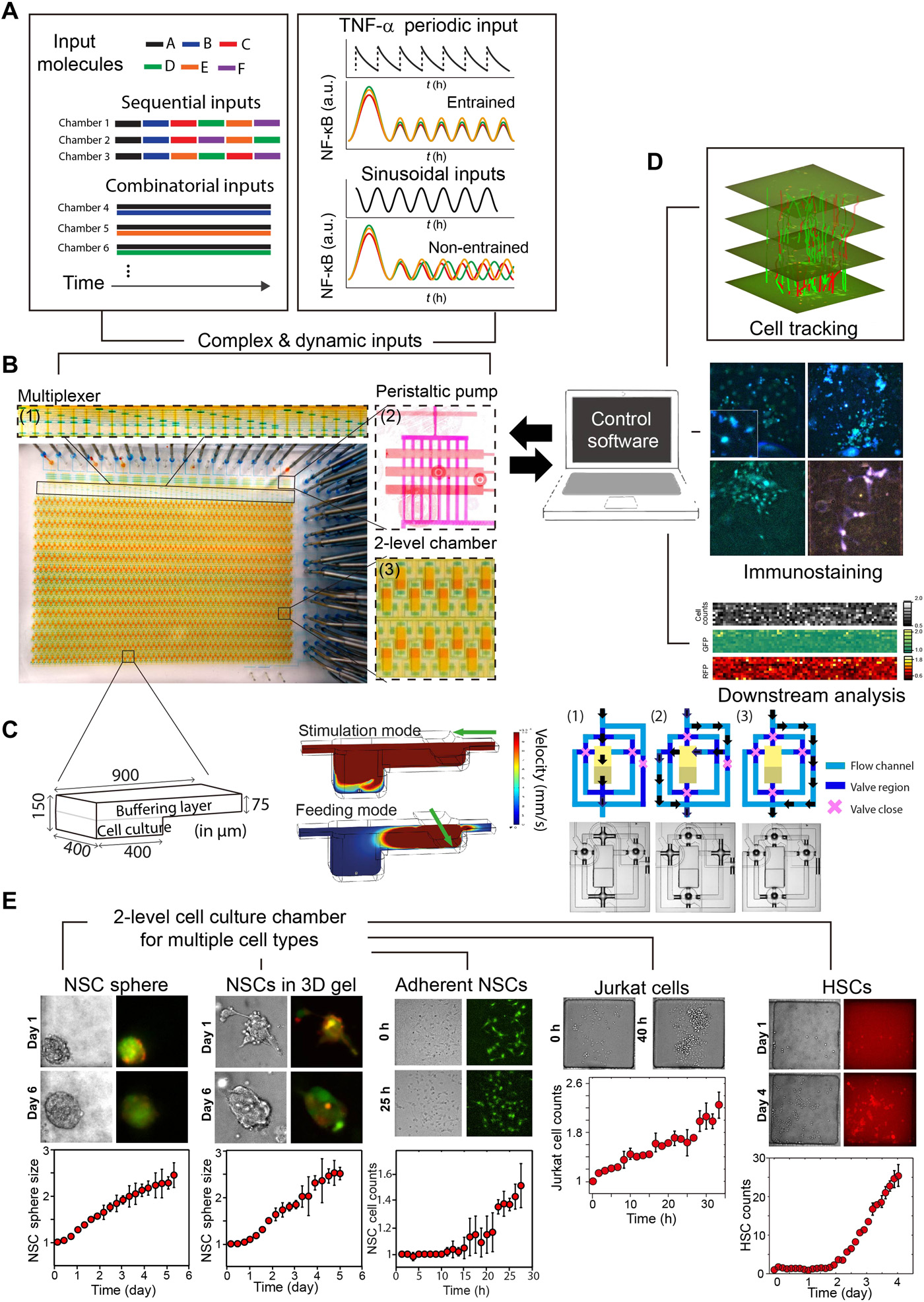
The microfluidic device contains 1500 independently programmable culture chambers. During a 1-week experiment, the device performs nearly 106 pipetting steps to create and maintain distinct culture conditions in each of the chambers.
ADVANTAGES
ADVANTAGES
- Enables high-throughput, automated culture, stimulation, and analysis of 3D organoids and single cells under precisely controlled dynamic conditions
-
Provides physiologically relevant microenvironments that better replicate tissue architecture and pathophysiology compared to traditional 2D cultures and animal models
-
Integrates real-time 3D imaging (phase contrast and fluorescence microscopy) for continuous monitoring of cellular responses and organoid development
-
Allows parallel experimentation with multiple, independently controlled fluidic channels for combinatorial drug screening and stimulation
-
Facilitates easy harvesting of organoids or single cells post-experiment for downstream molecular and cellular analyses
-
Supports diverse cell culture formats including adherent, nonadherent, monolayer, and 3D hydrogels/neurospheres, enhancing versatility
-
Minimizes reagent consumption and manual labor through automation, improving reproducibility and accelerating research workflows
-
Enables discovery of complex cellular signaling logic and fate decisions by delivering thousands of ligand combinations with temporal precision at single-cell resolution
APPLICATIONS
-
High-throughput drug screening
-
3D tissue modeling
-
Stem cell differentiation studies
-
Single-cell signaling analysis
-
Personalized cancer therapy testing
PUBLICATIONS