

Next-Generation Immunotherapy Platform With Engineered Collagen-Binding Cytokine Combinations
SUMMARY
Combination engineered IL-7 and IL-12 proteins that target tumors by binding to collagen, boosting immune attack on cancer while reducing side effects and improving long-term protection, even in cancers resistant to standard treatments
- Cancer immunotherapy is a rapidly evolving field that seeks to harness the body’s immune system to recognize and eliminate malignant cells. Traditional treatments such as chemotherapy and radiation often have significant side effects and may not provide lasting protection against tumor recurrence. Immunotherapies, including checkpoint inhibitors and cytokine-based treatments, have shown promise in improving patient outcomes, particularly by activating immune cells like T lymphocytes to target cancer cells. However, many tumors develop mechanisms to evade immune detection or suppress immune responses, leading to limited efficacy in certain patient populations. There is a growing need for therapies that can overcome these barriers, enhance immune cell function within the tumor microenvironment, and generate durable antitumor immunity.
-
Despite advances, current cytokine therapies face significant challenges. Systemically administered cytokines, such as interleukin-12 (IL-12), can cause severe toxicity at doses required for therapeutic efficacy, limiting their clinical utility. Moreover, these cytokines often fail to accumulate at sufficient concentrations within the tumor stroma, reducing their effectiveness and increasing the risk of off-target effects. Tumors can also induce immune cell exhaustion, particularly in CD8+ T cells, diminishing the long-term effectiveness of immunotherapies and leading to tumor relapse. Existing approaches struggle to maintain a balance between potent antitumor activity and manageable safety profiles, and they often do not promote the development of robust immunological memory needed to prevent cancer recurrence. These limitations underscore the need for innovative strategies that can localize immune activation to the tumor site, minimize systemic toxicity, and sustain effective immune responses.
- The faculty inventor developed a novel cancer immunotherapy that combines engineered forms of interleukin-7 (IL-7) and interleukin-12 (IL-12), each fused with a collagen-binding domain (CBD) to enhance their retention within the tumor microenvironment. By targeting collagen I in the tumor stroma, these modified cytokines accumulate at the tumor site, maximizing their local effects while minimizing systemic exposure. Used together, the CBD-IL-7 and CBD-IL-12 synergistically boost antitumor immune responses: they reduce exhaustion in CD8+ T cells, promote the development of durable immunological memory, and allow for lower, safer dosages of IL-12. The approach has demonstrated efficacy in multiple preclinical cancer models, including those resistant to standard checkpoint inhibitor therapies, and has shown compatibility with both intratumoral and systemic administration routes.
FIGURE
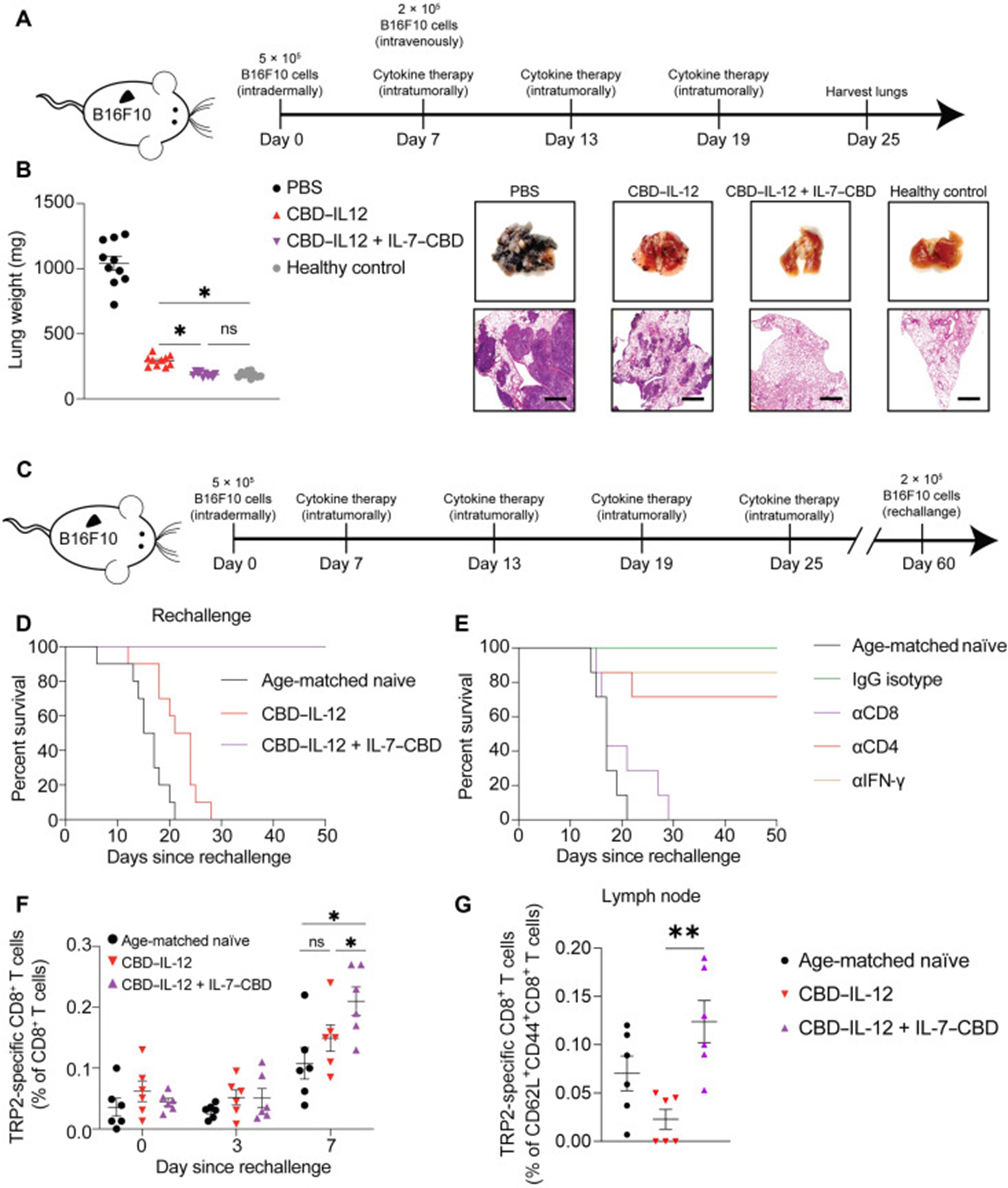 (A) B16F10-bearing mice were administrated with 2 × 10⁵ B16F10 intravenously on day 7 and treated with either PBS, 33.3 pmol of CBD–IL-12 or 33.3 pmol of CBD–IL-12 + 666 pmol of IL-7–CBD intratumorally on days 7, 13, and 19. (B) The lungs were harvested for measurement of metastasis nodules on day 25. (C and D) B16F10-free mice cured with 166.5 pmol of CBD–IL-12 [intratumorally (i.t.)] or with 33.3 pmol of CBD–IL-12 + 666 pmol of IL-7–CBD (i.t.) were rechallenged with 2 × 10⁵ B16F10 melanoma intradermally. (E) B16F10-free mice due to 33.3-pmol CBD–IL-12 + 666-pmol IL-7–CBD combination therapeutic schedule were rechallenged with 2 × 10⁵ B16F10 and injected with either immunoglobulin G (IgG) isotype, mouse CD8 antibody, mouse CD4 antibody, or mouse IFN-γ antibody on days −1, 2, 5, and 8. (F) The tumor-free mice due to 33.3-pmol CBD–IL-12 + 666-pmol IL-7–CBD combination were rechallenged with 2 × 10⁵ B16F10, and the blood was collected on the scheduled time point on days 0, 3, and 7 for quantification of the melanoma antigen (TRP2)–specific CD8+ T cells in the circulating lymphocyte. (G) The primary tumor-draining lymph nodes were harvested on day 11 for quantification of the melanoma antigen (TRP2)–specific CD62L+CD44+CD8+ T cells. Overall survival rates were compiled for two independent experiments, and statistical analyses were performed using log-rank (Mantel-Cox) tests. Melanoma lung metastasis nodules and TRP2-specific CD8+ T cells analysis was compiled for multiple comparisons, and statistical analyses were performed using one-way ANOVA tests or t test. *P < 0.05 and **P < 0.01.
ADVANTAGES
ADVANTAGES
-
Enhanced antitumor efficacy through synergistic action of IL-7-CBD and CBD-IL-12
-
Reduced immune cell exhaustion, particularly in CD8+ T cells, improving immune response quality
-
Induction of durable immunological memory, preventing cancer recurrence
-
Lower toxicity and immune-related adverse events compared to higher doses of IL-12 alone
-
Effective in tumors resistant to standard checkpoint inhibitor therapies
-
Allows dose reduction of the more toxic IL-12 component without compromising efficacy
-
Flexible administration routes including systemic and intratumoral delivery
-
Synergizes with existing checkpoint inhibitor therapies, enhancing overall treatment outcomes
APPLICATIONS
-
Checkpoint inhibitor-resistant cancer therapy
-
Adjuvant for existing immunotherapies
-
Prevention of cancer metastasis
-
Durable cancer immunological memory induction
PUBLICATIONS