

Small Molecule Therapeutics For Inducing Trained Innate Immunity And Enhanced Anti-Tumor Responses
SUMMARY
Small molecule drugs developed to induce trained immunity in macrophage cells resulting in a heightened pro-inflammatory response without triggering a primary immune response
- The field of innate immunity and its modulation has gained significant attention for its potential to enhance the body’s defense mechanisms against infections and tumors. There is a critical need to develop approaches that safely produce a lasting heightened state of immune readiness. Traditional immune activation methods often involve strong immediate responses that can result in severe side effects, making it challenging to achieve a controlled and sustained protective effect. Researchers have therefore sought ways to induce a measured and long-lived enhancement of innate responses, addressing the delicate balance between activation and safety.
-
Current approaches frequently rely on pathogen-derived or endogenous agents which, while effective at triggering immune reactions, also tend to provoke an undesirable immediate pro-inflammatory response. These methods can lead to adverse events by causing excessive inflammation and systemic toxicity. Moreover, issues with manufacturing consistency and standardization further complicate the use of such agents in clinical settings, underscoring the critical need for safer, more predictable therapeutic interventions that can reliably boost immune readiness without triggering harmful acute inflammation.
- The faculty inventor developed synthetic small molecules that reprogram macrophages to mount an enhanced pro-inflammatory response upon subsequent challenges. The compounds operate at nanomolar concentrations by inhibiting the anti-apoptotic Bcl-xL protein. The approach reprograms macrophages primarily through metabolic reconfigurations—specifically glycolysis-driven alterations—while sidestepping the immediate immune activation seen with pathogen-derived agents.
-
This technology is differentiated by its non-immunogenic profile, delivering trained immunity without triggering initial inflammatory responses. Unlike classical agents such as BCG or β-glucan, it avoids direct activation of the immune cascade, reducing the risk of adverse side effects.
-
In vitro studies and in vivo mouse models have demonstrated the compound’s capacity to boost cytokine production and enhance anti-tumor responses, particularly when combined with checkpoint inhibitors. Furthermore, the synthetic nature offers practical advantages in scalability and standardization, marking a significant improvement over pre-existing modulators of the immune system.
FIGURE
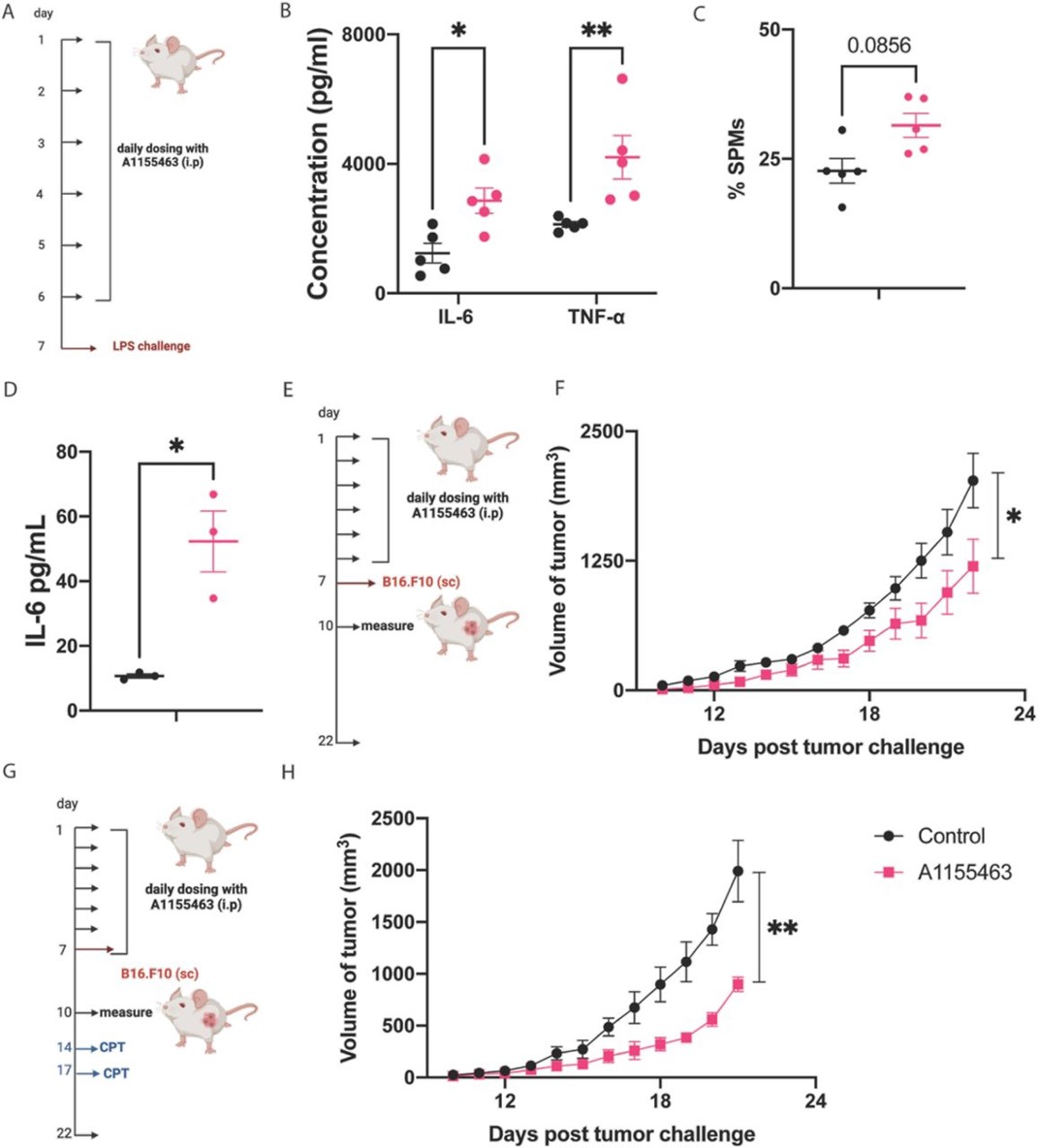
in-vivo TI assays
a) in-vivo training schedule-mice were dosed i.p. with training material (PBS or A1155463 at 15 mg/kg) daily for six days. Mice were challenged with 5 μg LPS on day 7. b) IL-6 and TNF-α levels 1 h following LPS challenge with either PBS (black) or A1155463 (pink); n= 5. c) % of SPMs from the peritoneal cavity of PBS (black) or A1155463 trained (pink) mice 2 h post LPS challenge on day 7. d) IL-6 levels from bone-marrow cells isolated on day 7 challenged ex-vivo with LPS from either PBS (black) or A1155463 (pink) trained mice; n= 3 e) in-vivo training schedule for B16.F10 tumor challenge f) Tumor volumes of mice trained with PBS (black) or A115463 (pink) mice; n= 8. g) in-vivo training schedule for B16.F10 tumor challenge with checkpoint therapy (CPT) administered on day 14 and 17. h) Tumor volumes of mice trained with PBS (black; n=4) or A115463 (pink; n=5).
ADVANTAGES
ADVANTAGES
- Non-immunogenic induction of trained immunity without triggering a primary inflammatory response
-
High potency at nanomolar concentrations achieving effective immune reprogramming with minimal toxicity
-
Synthetic nature allows for easier manufacturing, purification, and standardizatio
-
Enhances cytokine production and anti-tumor responses, particularly when combined with checkpoint therapies
-
Induces metabolic reprogramming via glycolysis rather than causing significant apoptosis or inflammatory side effects
APPLICATIONS
- Cancer immunotherapy
- Vaccine adjuvant