

New Toolkit And Methods For Large-Scale Spatial Transcriptomics
SUMMARY
Tools and methods to map the entire transcriptome with large-scale histology sections from whole animal or whole human organs with high resolution and sensitivity
The Unmet Need: Research tools to measure whole-tissue gene expression across mammalian organs
- Immune cells are present in every organ of the body and every cell in the body carries immunological functions. To understand the rules of interdependency between immune cells and processes across multiple organs, it is crucial to study immune responses at the scale of the entire organism.
-
Currently, there are a lack of experimental approaches to systematically track the organism-wide processes that take place during immunological or other physiological responses in mammals. Deciphering the immune system at the scale of the whole organism is crucial to understanding fundamental problems in immunobiology and physiology, and to manipulate immunity for maintaining health and preventing disease. Thus, a fundamental challenge in immunology today is to develop new ways to study the structure, regulation and function of the immunological events that cross organ boundaries.
-
Recent advances in the field of spatially resolved transcriptomics have enable the sequencing of the transcriptome associated with specific areas of tissue sections. Commercially available kits remains limited by low resolution, small surface area, and high costs. In addition, the limitations of this commercial platform compound with issues of standard freeze-sectioning techniques that are prone to section loss and damage. These gaps in spatial transcriptomic and histology technologies prevent spatiomolecular analyses across many samples for detailed studies of temporal processes, patient cohorts, or spatial atlases in two or three dimensions.
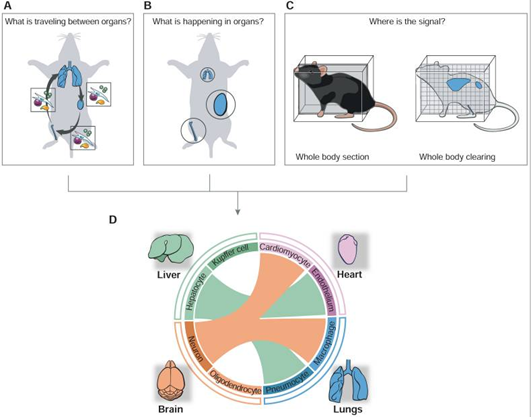
- The faculty inventor developed methods and tools to obtain whole-body spatial transcriptomics maps in mice from large-scale histology sections with applicability to large human tissue samples. Additionally, data-driven models to understand and predict the spatiotemporal dynamics of whole-body inflammation events were established. The spatial transcriptomics measurements show the transport, accumulation, and effects of inflammatory signals between interconnected subsystems (i.e., organs and cells.). These innovations fill a unique gap for studying organism-wide processes in immunology and physiology.
FIGURE
ADVANTAGES
ADVANTAGES
-
100x improvement in scale compared to existing spatial transcriptomics commercial solutions
-
Improved resolution
-
Low-cost solution
APPLICATIONS
- Spatial transcriptomics
- Research Tools
PUBLICATIONS