

Co-intercalation-free Ether Solvent for Lithium Ion Batteries
SUMMARY
- Lithium-ion batteries have revolutionized portable electronics, but there remains room for improvement in energy density, electrochemical stability, and usable temperature window. An improvement in electrolytes can further such needs for the next-generation Li-ion battery.
- Current state of the art electrolytes are compositions based on ethylene carbonates, but these are limited by an operating temperature window of −20°C to 40°C and lack of compatibility for fast charging and different battery chemistries.
- The faculty inventor has identified a substitute for carbonate-based electrolytes – a class of compounds called fluorinated ethers, which are able to support reversible lithium-ion intercalation and deintercalation within graphite. This is the first time that such compounds have been found to show this mechanism.
FIGURE
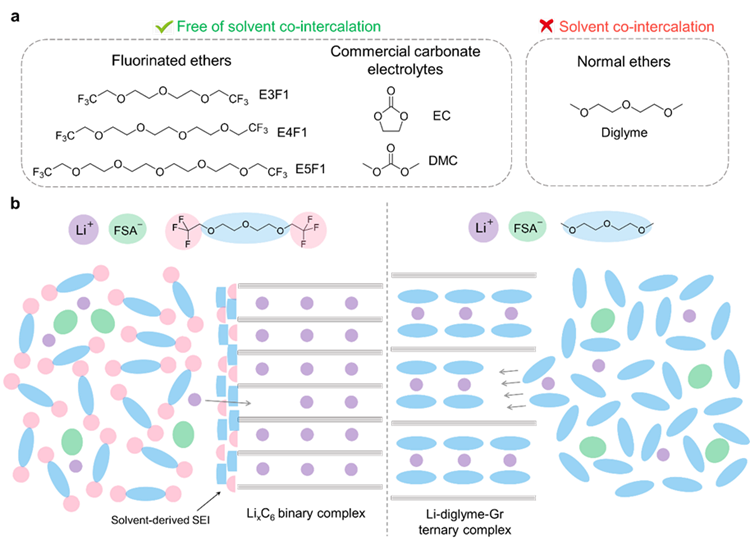
Molecular structure of solvents studied in this work. b, Illustration of the influence of fluorination on ether solvent performance with graphite electrode: Fluorinated ethers (E3F1) can suppress solvent co-intercalation by passivating graphite surface with a solvent-derived solid electrolyte interphase (SEI) while normal ether (diglyme) tends to co-intercalate due to the lack of a robust SEI.
ADVANTAGES
ADVANTAGES
- Extension of Li ion battery performance with higher energy densities
- Allows wider worker temperature windows
- Higher (electro)chemical stabilities
APPLICATIONS
- Energy storage systems
- Consumer electronic goods
- Electric mobility