

Atomic Layer Chemical Pattern For Block Copolymer Assembly
SUMMARY
- Block copolymers can assemble into large-scale, dense, and regular nanoscale patterns, making block copolymer assembly a potential candidate for nanolithography. The assembly of block copolymers can be directed to follow a chemical pattern to generate a regular structure.
- Notwithstanding the success of existing approaches, current chemical patterning methods are limited by deterioration of wetting behavior, processing temperatures, and topological variation. These issues manifest in poorly assembled structures, which ultimately limits pattern transferability, scalability, and the commercial appeal.
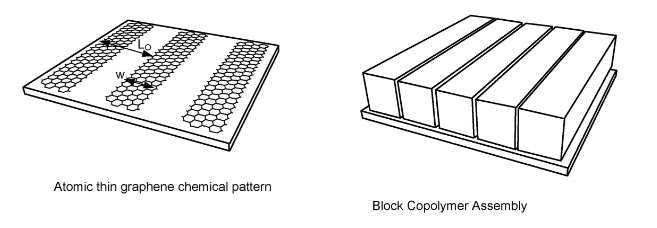
- This invention addresses these shortcomings through a patterned single atomic layer to direct the assembly of block copolymers. Using single atomic layers results in flat, uniform topography that shortens assembly time, increases the areal coverage of the assembly pattern, improves pattern flexibility, and enables access to high-density patterning.
- The faculty inventor has demonstrated that a uniform, wafer-scale graphene layer can generate a regulated lamellae di-block copolymer pattern with enhanced performance, showing the promise of the approach and its potential superiority to standard polystyrene based chemical patterning.
FIGURE
ADVANTAGES
ADVANTAGES
- Highly controllable, directed self-assembly
- Uniform scalability for improved manufacturability
- Reduced self-assembly time for increased manufacturing throughput
- Higher tolerance to temperature and stretchability improving manufacturing robustness
APPLICATIONS
- Polymer self-assembly
- Nanolithography
- Chemical epitaxy