

A New Genetic Medicine Strategy For Treating Neurological Disorders
SUMMARY
- Synaptic transmission and plasticity are fundamental to neuronal functions, and alterations of synaptic protein expression are direct causes of autism, intellectual disability (ID), and epilepsy.
-
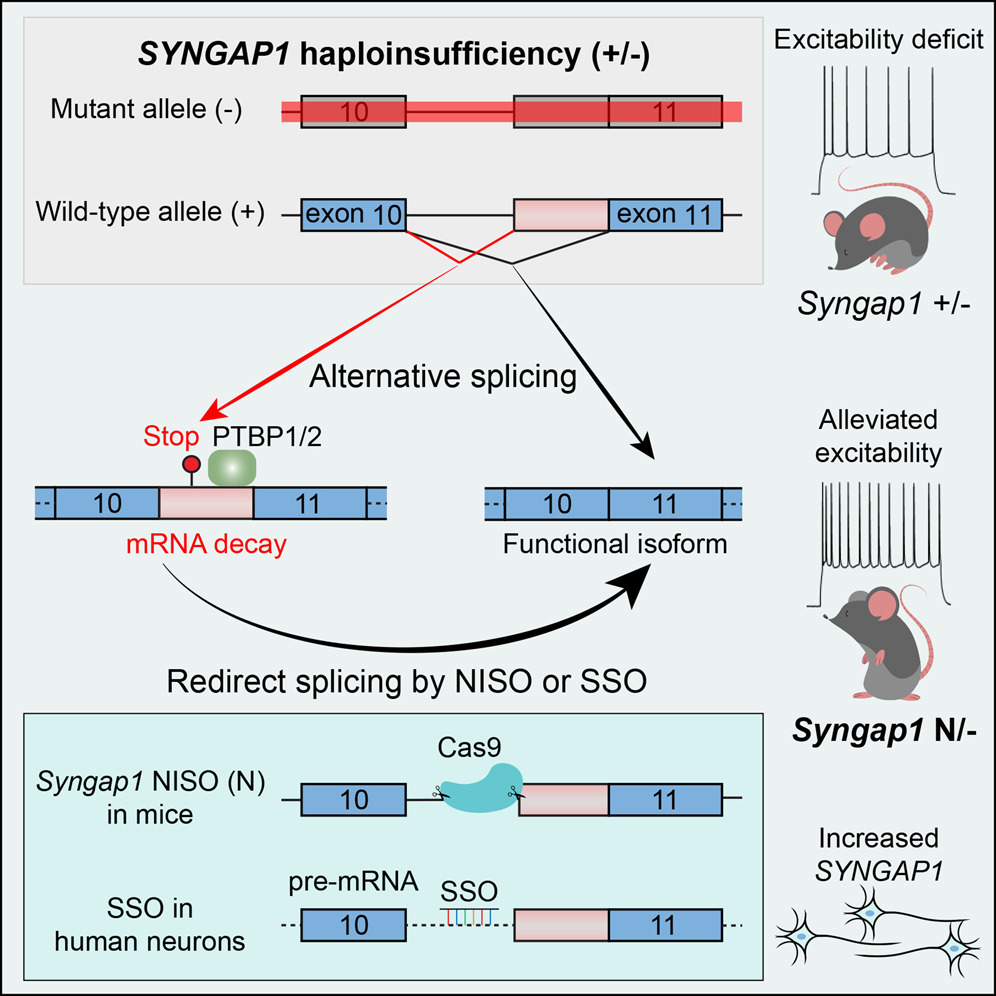
De novo loss-of-function (LoF) mutations in SYNGAP1, encoding the synaptic Ras GTPase-activating protein, are among the most prevalent causes of ID and autism spectrum disorders.
-
Alternative splicing coupled with nonsense-mediated mRNA decay (AS-NMD) is a translation-dependent mechanism which promotes the degradation of mRNAs with premature translation-termination codons. Recent success in splice-switching oligonucleotides (SSOs) suggests that redirection of splicing through SSO ablations is a viable approach to rescue haploinsufficiency.
-
The faculty inventor has designed SSOs to suppress critical intronic elements essential for premature translation termination allowing for increased productive transcripts of SYNGAP1 in neurons.
FIGURE
ADVANTAGES
ADVANTAGES
-
Higher efficiency in repressing SYNGAP1 AS-NMD leading to increased Syngap1 protein detection
-
Lower toxicity to neurons
APPLICATIONS
-
Autism Spectrum Disorder
-
Intellectual Disorder
-
Epilepsy
- Validated through human induced pluripotent stem cell-derived neurons