

Point Of Care Monitoring Of Inflammatory Diseases
SUMMARY
A quantitative method of calprotectin measurement from various biological samples to monitor disease severity, progression, and effectiveness of treatment interventions in inflammatory diseases.
- Calprotectin, a metal ion-binding protein complex, plays a crucial role in the innate immune system and has gained prominence as a biomarker for various intestinal and systemic inflammatory and infectious diseases, including inflammatory bowel disease (IBD) and tuberculosis (TB).
-
Calprotectin is released from neutrophils and epithelial cells at sites of infection or inflammation, where it inhibits pathogen growth by sequestering environmental transition metal ions, such as Ni2+, Zn2+, and Mn2+. Its biostability and correlation with host immunity make calprotectin a useful marker of infection or inflammation.
-
Currently, clinical testing for calprotectin levels relies on enzyme-linked immunosorbent assays (ELISAs), which require trained personnel and expensive equipment and are therefore limited to laboratory settings and less accessible to low-resource areas. Specifically, data collection of fecal calprotectin levels is usually impeded by low patient compliance to fecal immunochemical testing in general, and specifically among patients with IBD, with the necessity of sample transportation to the clinic as a primary deterrent, making monitoring disease progression and guiding management challenging for the physicians and their patients.
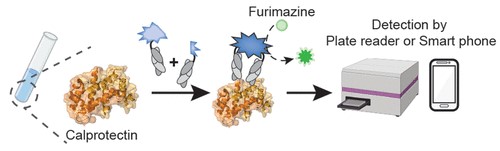
- The faculty inventor introduces the Fab-Enabled Split Luciferase Calprotectin Assay (FESCA) to quantitatively measure calprotectin. The method utilizes two new fragment antigen binding proteins (Fabs) which bind to different epitopes of the calprotectin complex. The Fabs and are fused with split nanoluciferase fragments which form active luciferase upon binding to calprotectin either in solution or in varied immobilized assay formats.
-
FESCA can detect physiologically relevant calprotectin levels across various sample types, including serum, plasma, whole blood, and stool extracts. Notably, FESCA's output luminescence can be measured with standard laboratory equipment, as well as consumer-grade cell phone cameras.
-
FESCA presents a convenient, low-cost, and quantitative method for assessing calprotectin levels in various biological samples, with the potential to improve the diagnosis and monitoring of inflammatory diseases, especially in at-home or point-of-care settings.
FIGURE
ADVANTAGES
ADVANTAGES
-
Convenient, low-cost
-
Simpler alternative to ELISA
-
Compatible with consumer-grade cameras
APPLICATIONS
- Diagnostics
-
Infectious disease
-
Research tool