

Enhanced Nitrogen Vacancy Synthesis in Diamond: Minimizing Hydrogen Passivation
SUMMARY
Keywords: Electron radiation effects, Ion implantation, Spectroscopy, Chemical vapor deposition, Optical fibers, Quantum information
This method mitigates hydrogen passivation of nitrogen vacancy centers (NV centers) in diamond through vacuum annealing after plasma-enhanced chemical vapor deposition, which leads to an increased yield from NV center synthesis.
The Unmet Need: Low yield of nitrogen vacancy center based qubits
The negatively charged NV center in diamond is a promising defect-based spin qubit for many quantum applications. Single NV centers, necessary for high-spatial resolution quantum sensing as well as quantum communication schemes, and ensembles of NV centers, for high-sensitivity sensing, may be synthesized with controlled densities and spatial localization via plasma-enhanced chemical vapor deposition (PE-CVD).
PE-CVD diamond growth operates in a majority hydrogen plasma environment, and hydrogen ions from plasma are known to diffuse into diamond, which may, in turn, passivate NV centers by converting them into hard-to dissociate nitrogen vacancy hydrogen centers (NVH centers). As such, hydrogen can form defect complexes with vacancies and NV centers during NV activation annealing, precluding NV center formation either by capturing vacancies and converting them to VHx centers or by passivating NV centers to form NVHx centers, which are optically dark spin defects.
These defects are stable up to around 1800◦C and thus are not annealed out during typical thermal processing. These processes are of concern with regards to NV center conversion efficiency, as the crystal contains substitutional nitrogen (Ns), vacancies, and hydrogen post-growth, before the formation anneal.
The Proposed Solution: Vacuum annealing to mitigate hydrogen passivation
David Awschalom has developed a method to minimize this undesired NVH center formation: an extra anneal step is completed after the PE-CVD growth step to diffuse the residual hydrogen out of the diamond crystal (“hydrogen out-gassing”).
This additional step removes hydrogen from the crystal before subsequent vacancy and NV center formation, thus preventing the hydrogen passivation and increasing the yield of NV center synthesis.
FIGURE
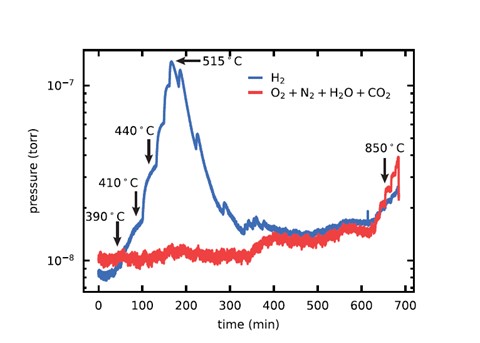
Hydrogen out-gassing. Pressure of chamber gasses measured while heating up a diamond sample post-growth to 850 ◦C. Above 500 ◦C the H2 pressure increases for around 3 h, indicating the diamond out-gasses H2, while the partial pressure of other chamber gasses remains relatively unchanged. There is minimal change observed in other measured gasses.
ADVANTAGES
Advantages
- Higher purity
- Increased yield
- Improved control over device fabrication
- Decreased defect formation
- Improved efficiency
Applications
- Nitrogen Vacancies in Diamond
- Quantum Sensing
PUBLICATIONS
- Kenichi Ohno, F. Joseph Heremans, Lee C. Bassett, Bryan A. Myers, David M. Toyli, Ania C. Bleszynski Jayich, Christopher J. Palmstrøm, David D. Awschalom; Engineering shallow spins in diamond with nitrogen delta-doping. Appl. Phys. Lett. 20 August 2012; 101 (8): 082413. https://doi.org/10.1063/1.4748280