

Method for Controllable Strain Generation in Diamond Membranes
SUMMARY
This method enables non-invasive, predictable and controllable strain generation in diamond membranes, while improving spin coherence and enabling microwave control.
The Unmet Need: Scaling networking technologies in diamond
Group-IV color centers in diamond are a leading material platform in quantum photonics. These color centers have risen to prominence in quantum networking and sensing applications due to their excellent optical coherence. This platform has been used in demonstrations of memory enhanced quantum key distribution, two qubit entanglement, and shaped single photon sources.
However, these demonstrations have necessitated operation in dilution refrigerators at sub-Kelvin temperatures with vector magnets. These systems are costly (as much as $600K) and resource intensive, requiring entire rooms for operation. Additionally, these color centers cannot be efficiently addressed by microwaves and necessitate complex two-laser all-optical control schemes that suffer from a trade-off between fidelity and speed. As such, these factors significantly impede efforts to scale networking technologies in diamond.
Recently, engineered strain has emerged as a method to further improve and tune critical quantum state properties of group-IV color centers as applying strain to the diamond – the host material of these color centers – can modify their energy levels, improve their electronic and optical properties, and enable new control schemes. The degree of improvement is limited by the strain magnitude. However, attempts to develop on-chip strain generation methods have been unpredictable, uncontrollable, and have achieved low magnitudes of strain.
The proposed solution: Bonding to substrate
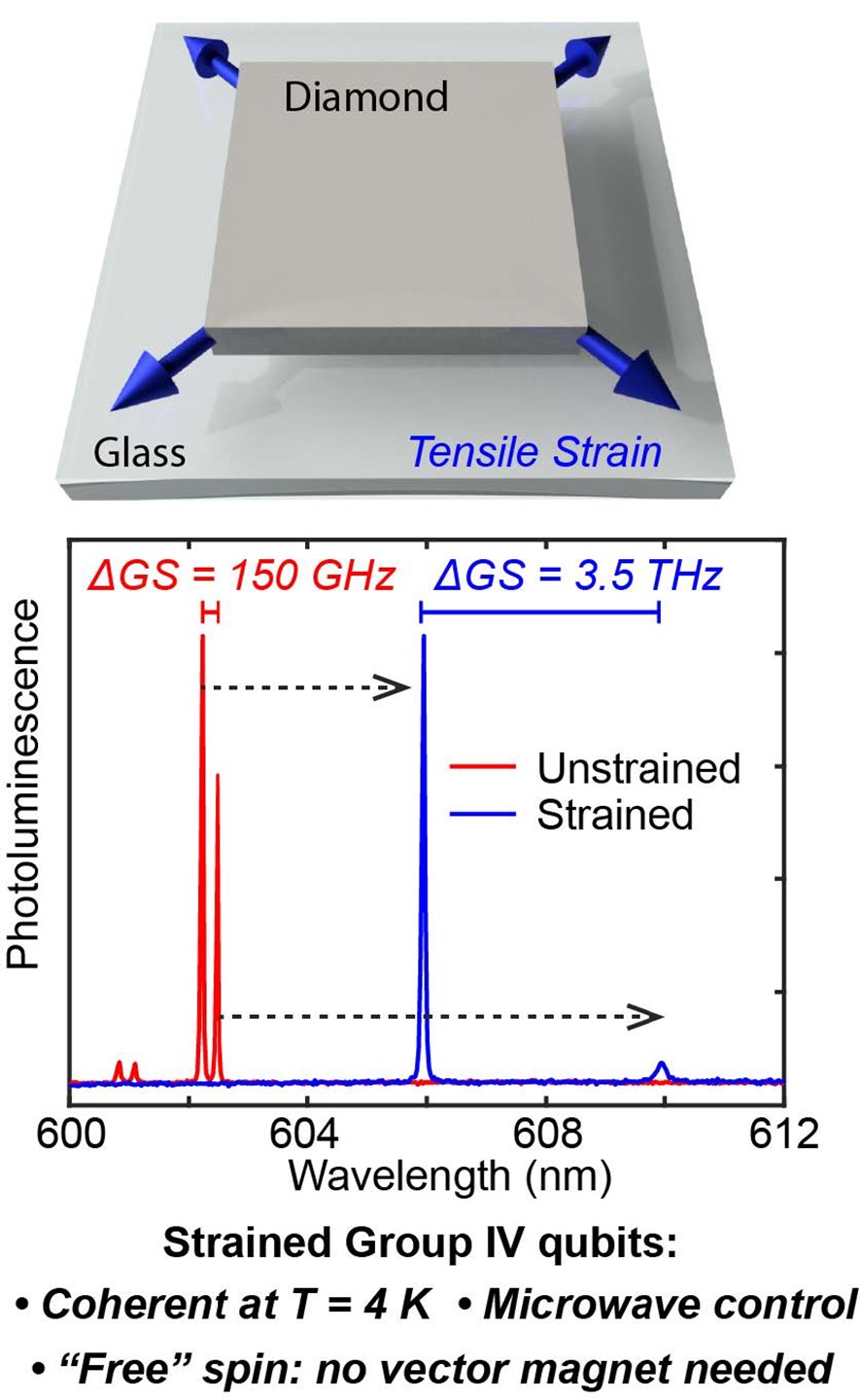
The inventors of this technology have developed a method to controllably generate strain in diamond membranes by bonding them to SiO2-based substrates for tensile strain and non-SiO2-based substrates for compressive strain with hydrogen silsesquioxane electron beam photoresist. This heterogeneous structure enables non-invasive strain generation with a uniform distribution across the sample and does not introduce additional decoherence to the color centers.
Additionally, this method can achieve degrees of strain at least one order of magnitude greater than other on-chip methods leading to improved spin coherence in color centers as well as enabling microwave control of the color centers.
FIGURE
ADVANTAGES
ADVANTAGES
-
Compatible with many on-chip integrations and nanofabrication techniques
-
Improved spin coherence
-
Enables microwave control
-
Non-invasive strain generation
-
Predictable and controllable strain generation
APPLICATIONS
- Nitrogen Vacancies in diamond
- Neutral Silicon Vacancies in diamond
- Indium Arsenide quantum dots
- Silicon qubits
- 2D Materials
- Quantum optomechanics and phononics
PUBLICATIONS
- https://arxiv.org/pdf/2307.11916.pdf
- https://journals.aps.org/prx/pdf/10.1103/PhysRevX.13.041037