

Computational Framework For Unraveling Single-Cell Transcriptional Dynamics
SUMMARY
Novel system using statistical topic modeling and a bursty transcriptional model to analyze spliced and unspliced RNA, revealing precise cell state transitions and dynamics in complex biological systems
- Single-cell RNA sequencing has revolutionized our ability to understand complex biological systems by enabling researchers to study gene expression at an unprecedented resolution. This field has emerged from the growing need to decipher how individual cells function, differentiate, and interact in diverse biological contexts. As cellular processes are inherently dynamic, there is a critical demand for methods that can capture and quantify these transcriptional changes over time, providing insights into cell state transitions and developmental trajectories.
-
Despite promising advances, current analytical approaches struggle with inherent limitations that compromise their utility. Many methods rely on uniform parameter settings across heterogeneous cell populations, failing to acknowledge distinct transcriptional programs in different cell types. Additionally, these approaches often inadequately address the highly dispersed transcript counts resulting from transcriptional bursting, leading to inaccurate inference of kinetic parameters. The oversimplification of complex, stochastic gene expression dynamics culminates in sub-optimal estimates of cell-state transitions, ultimately impeding our ability to accurately map cellular trajectories in multifaceted biological systems.
- The faculty inventor integrated advanced computational techniques to analyze single-cell RNA sequencing data by estimating RNA velocity, which reflects the dynamic rate of gene expression change. It first dissects complex datasets using probabilistic topic modeling to identify distinct gene programs and cell subpopulations, revealing nuanced transcriptional dynamics. Next, it applies a transcriptional burst model that captures the stochastic nature of gene expression through integer transcript counts, offering precise kinetic parameter estimation. This dual-phase framework enables detailed mapping of cellular transitions and fate decisions, even in complex biological systems punctuated by transcriptional variability.
-
The novel approach confers ability to overcome the limitations of conventional models that apply uniform parameters across all cells and struggle with dispersed transcript counts. By deriving process-specific parameters and leveraging a realistic burst model, it accurately disentangles overlapping transcriptional processes. As a result, the technology not only improves the resolution of biological trajectory inference but also corrects erroneous transition directionality often observed in standard methods—delivering a more robust, interpretable, and precise analysis of cellular state dynamics.
FIGURE
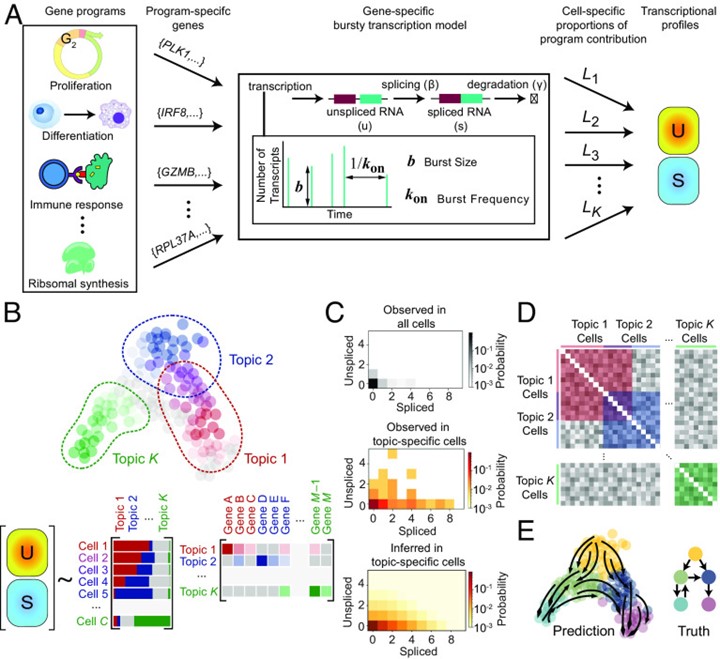
TopicVelo combines topic modeling and a burst model for accurate, robust RNA velocity inference
ADVANTAGES
ADVANTAGES
- Enables process-specific parameter inference tailored to distinct cell programs
-
Incorporates a realistic bursty transcription model for improved accuracy
-
Delivers interpretable feature extraction through probabilistic topic modeling
-
Accurately recovers complex cell trajectories and terminal states
-
Corrects directional flow errors common in standard RNA velocity methods
APPLICATIONS
- Drug discovery
- Personalized medicine diagnostics
- Stem cell therapy optimization
- Cancer cell dynamics analysis
- Immunotherapy response modeling