

Bio-inspired Artificial Intelligence For Rapid Multi-Task Learning
SUMMARY
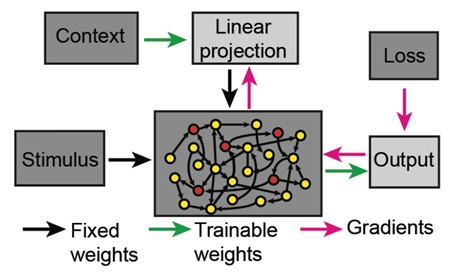
- Multi-task learning is a subfield of machine learning in which multiple tasks are simultaneously learned by a shared model. Biologically-inspired recurrent neural networks (RNNs), trained using backpropagation, can learn an impressive array of complex tasks, and offer the opportunity for detailed examination of network activity and circuit structure.
- Training RNNs using backpropagation is usually performed by treating all synapses as plastic, creating issues relating to learning speed and catastrophic forgetting (i.e., caused by applying different weights for different tasks to a given synapse). Enabling machines to learn as quickly and robustly as humans requires an approach for learning general underlying concepts, which are applicable between tasks, and applying these concepts to new and unfamiliar situations.
- The faculty inventor has demonstrated that rapid learning with localized plasticity can be accomplished with purely local error signals, without backpropagation, using a reinforcement learning setup, suggesting that rapid learning in artificial, and potentially biological agents, can be accomplished with mostly rigid networks.
FIGURE
ADVANTAGES
ADVANTAGES
-
Improved data efficiency
-
Reduced model overfitting
-
Rapid model learning
-
Computationally efficient through eliminating backpropagation
APPLICATIONS
-
Multi-task machine learning
-
Natural language processing
-
Autonomous vehicles
-
Speech recognition
-
Computer vision
-
Drug discovery