

Practical Architectures and Algorithms for Quantum Source Coding
SUMMARY
- Data compression done by classical source coding is a crucial element of modern digital infrastructure as it enables the efficient storage and transmission of images, audio files, and videos. Protocols for quantum source coding are increasingly useful to enable more efficient storage and transmission of quantum data among emerging quantum infrastructures. However, despite developments in quantum source coding schemes severe practical challenges have prevented their implementation.
- There are three prominent challenges that plague existing quantum source coding schemes
- Complex operations and/or deep circuits of the source code are out of reach for near-term devices
- Application of these schemes to general purpose quantum computing architectures complicate implementation with significant overhauls and slowdowns
- Existing schemes are based on a qubit intensive system, block-coding, to guarantee a near lossless compression at near-optimal rates
- The inventors have worked to improve the practicality of quantum compression through their protocols in quantum source coding
- With minimal additional overhead resilience to noise is achievable so that the qubit error rate scales only polylogarithmically with the message size
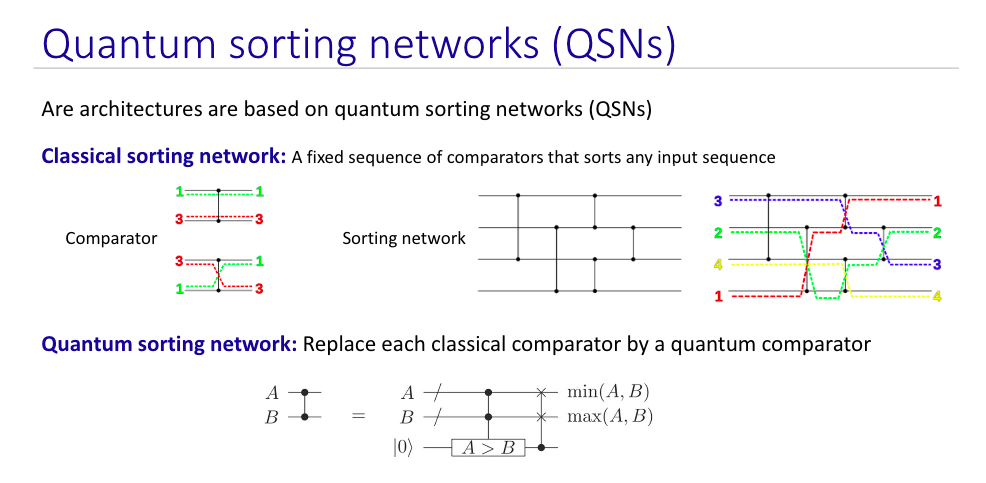
- The proposed specialized class of architectures and accompanying algorithms are based on quantum sorting networks characterized by logarithmic running times showcasing their easy implementation
- A proposed simple blocking procedure reduces quantum hardware cost and the susceptibility to noise while increasing compression rates making them particularly appealing for near-term devices
- A simplified source coding scheme, “excitation coding”, greatly reduces the required resources and complexity for increased compression rates.
FIGURE
ADVANTAGES
ADVANTAGES
- The practical benefits of quantum sorting networking architectures are translated into an entirely new application.
- Avoids the complex operations and/or deep circuits of quantum source coding.
- Near-term device implementation is far more feasible.
- Novel transformation of noise-resilient classical sorting networks into noise-resilient quantum sorting networks.
- Blocking favors the implementation of quantum source coding.
APPLICATIONS
- Quantum Communication
- Quantum Sensing (telescopes)
- Quantum State Preparation (Hamiltonian simulation)
- Quantum Tomography