

Stretchable Light-Emitting Polymers
SUMMARY
-
Electroluminescent (EL) devices represent one of the central components of multiple modern technologies. They offer unique functionality for information visualization, wireless signal/power transmission and medical therapies. After decades of development, organic light-emitting diodes (OLEDs) have become one of the most advanced EL technologies, particularly for the display industry, owing to advantages that include high efficiency, high brightness, low-voltage operation, low prices, large-area scalability and mechanical bendability.
-
Recently, a growing desire to intimately integrate electronics with the human body in the form of wearable and implantable devices has spurred new needs for the additional development of EL devices, particularly along the lines of incorporating skin-like softness and stretchability. The development of stretchable OLEDs that are compatible for integration with soft human body and tissue is highly desirable for enabling visual readout of sensing data through a soft display integrated with artificial electronic skin systems.
-
There have been excellent demonstrations of flexible OLEDs, including the fabrication of highly flexible and monolithically integrated active-matrix organic OLEDs. However, uniaxial stretchability is more desirable, which is more challenging to realize than flexibility, as flexible devices need to withstand strains less than 1%, whereas stretchable devices need to be able to accommodate strains of over 10%.
-
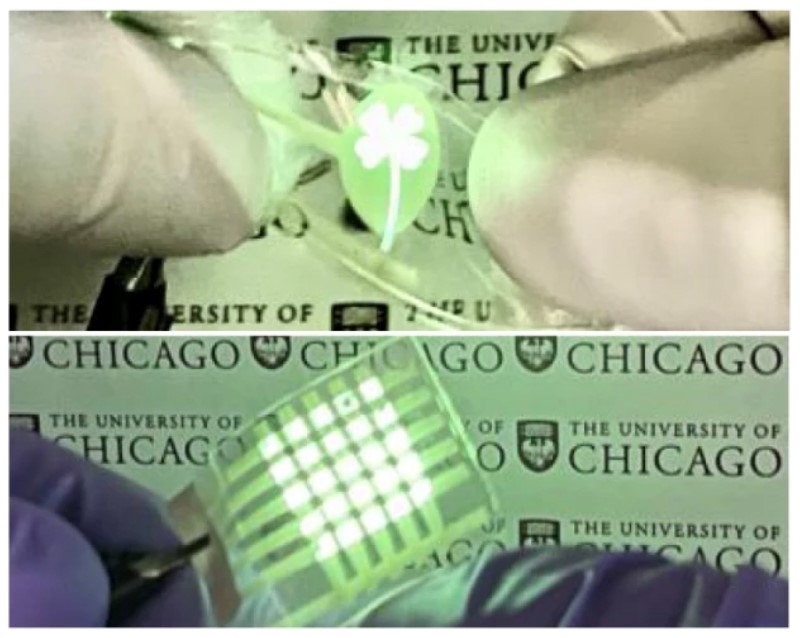
The inventors have developed a series of intrinsically stretchable light-emitting polymers (is-LEP) with thermally activated delayed fluorescence (TADF). The novel is-LEPs show both stable photoluminescence and electroluminescence performance up to 100% strain. The inventors also demonstrated that the is-LEPs allow the production of fully stretchable high-performance OLED devices.
FIGURES
ADVANTAGES
ADVANTAGES
-
Substantial stretchability without affecting the underlying electroluminescent processes
-
Superior maximum external quantum efficiency
-
High efficiency, brightness, and switching speed
-
Low driving voltage
APPLICATIONS
-
On-skin displays
-
Optical sensors (i.e. oxygen saturation monitors)
-
Wearable display systems and other electronics
-
Implanted optical stimulation (i.e. optogenetics)