

Novel Metabolite-Based Diagnostic Technology for Accurate Cavernous Angioma Identification and Risk Assessment
SUMMARY
Newly identified plasma metabolites linked to cavernous angioma, a neurovascular disease, using machine learning and multi-omics data to improve diagnostic precision and offer new insights for developing specific biomarkers
The problem: Lack of accurate cavernous angioma biomarkers to distinguish high-risk cases
- Neurovascular diseases such as cavernous angiomas (CAs) present significant challenges to the healthcare field, affecting approximately 0.5% of the population and potentially resulting in severe neurological complications. These conditions are characterized by abnormal blood vessel formations in the brain and spinal cord, often leading to symptoms ranging from headaches to seizures and strokes. The only current treatment of CAs is surgical resection of symptomatic lesions, which is associated with high morbidity and costs, and is limited in cases of multiple brain lesions.
-
Although research has offered insights into the genetic factors and microbiome compositions associated with CAs, current diagnostic and therapeutic approaches remain insufficient. The integration of multi-omics data, including metabolomic analyses, is increasingly gaining attention for its potential to uncover novel biomarkers and mechanisms underlying these diseases, thereby fulfilling the urgent need for more sensitive and specific diagnostic tools.
-
However, despite advances in genomics, proteomics, and microbiome studies, existing approaches have notable limitations. Many current diagnostic methods rely on imaging techniques and genetic tests that may not capture the full spectrum of disease variability or severity. These methods often fail to provide a complete mechanistic understanding of disease progression, making it difficult to differentiate between familial and sporadic cases or to appropriately gauge disease severity.
-
The lack of precision in current approaches hampers early diagnosis and risk assessment, ultimately affecting patient outcomes. Therefore, innovative solutions that can integrate diverse biological datasets to enhance diagnostic accuracy and provide deeper mechanistic insights are critically needed in the neurovascular disease landscape.
- The faculty inventor, Issam Awad, identified 22 novel plasma metabolites significant for diagnosing and understanding cavernous angiomas (CAs), a neurovascular disease. The integration of these plasma metabolites, coupled with a Bayesian approach and machine learning algorithms, has enhanced diagnostic precision and risk assessment to near-perfect accuracy. This advancement marks the first-time metabolomics and multi-omics data have been combined to develop sensitive and specific biomarkers for CAs.
-
The new technique not only identifies specific plasma metabolites associated with various aspects of CA but also employs machine learning to analyze combinations of these markers. This methodology not only improves diagnostic accuracy but also provides deeper mechanistic insights into the disease. By linking metabolites to the permissive microbiome and genetic factors, the technology offers a holistic view of CA pathology, aiding in better patient stratification and personalized treatment strategies.
FIGURE
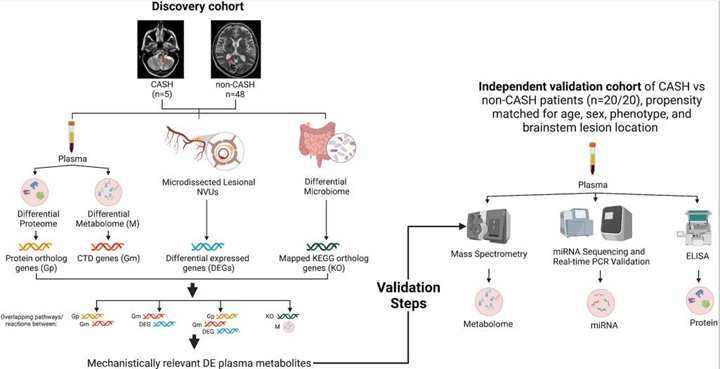
Methodology for analytic multi-omics integration of differential plasma metabolome and proteome, microbiome and lesional transcriptome, in cavernous angioma (CA) disease.
A pipeline was implemented to study the integration of multiomic datasets of CA disease. The interacting Comparative Toxicogenomics Database (CTD) genes and their associated Kyoto Encyclopedia of Genes and Genomes (KEGG) pathways of the differential plasma metabolite (p < 0.05, FDR corrected; Bayes factor>3) were first identified and then analytically compared to the enriched-KEGG pathways of the differential plasma proteome, and lesional transcriptome (p < 0.05, FDR corrected; Bayes factor>3). The differential metabolites were then validated in an independent cohort, propensity matched for age, sex, brainstem lesion, and genotype. NVUs neurovascular units.
ADVANTAGES
ADVANTAGES
-
Identification of 22 novel plasma metabolites linked to the permissive microbiome and genes implicated in CA disease
-
Can distinguish CA and patients with symptomatic hemorrhage, disease severity, and familial vs. sporadic CA
-
First integration of multi-omics data for mechanistic insights in CA disease
-
Development of sensitive and specific biomarkers for neurovascular disease
APPLICATIONS
-
Cavernous angioma diagnostic tools
-
Biomarker discovery
-
Risk assessment algorithms
-
Neurovascular disease research tools