

A Stretchable And Strain-Insensitive Pressure Sensor
SUMMARY
-
Pressure sensors are essential to a vast array of applications, where they sense and measure pressure, and transmit information, which help ascertain the performance of a given device. In fact, the size for the global pressure sensor market was estimated to be $11.38 billion in 2019, and is expected to reach $24.84 billion by 2027 at the CAGR of 10.3% from 2020 to 2027.
-
For the emerging field of soft electronics that has been rapidly developed for conformably interfacing with soft and dynamic human or robotic bodies, pressure sensing is a core function for a wide range of desired applications ranging from wearable health monitoring and prosthetic e-skins, to human-machine/robot interactions.
-
To provide stable, high-fidelity and irritation-free functions on these soft, curvilinear and deforming surfaces, pressure sensors are desired to have skin-like stretchability, which needs to be combined with the most important requirement for sensors—highly accurate and perturbation-free signal detection.
-
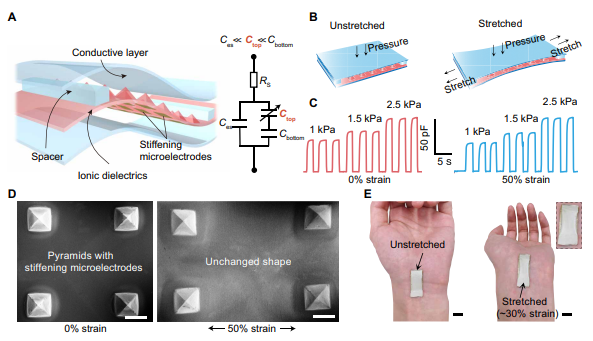
However, despite several reports of stretchable pressure sensors, their quantitative sensing performances to pressures are all significantly altered by the applied stretching. This has been a major impediment for realizing a wide range of sophisticated functions that need highly quantitative and real-time measurement and/or control of on-skin pressures.
-
This technology overcomes this challenge, and is a novel, stretchable pressure sensor, which can seamlessly adhere to soft/dynamic surfaces and maintain conformability under surface deformation. More importantly, the sensing performance is unaltered at up to 50% strain, which is necessary to quantitatively measure on-skin pressure.
FIGURE
ADVANTAGES
ADVANTAGES
- Stretchable and strain-insensitive pressure sensor that performs extremely well under strain compared to currently available stretchable pressure sensors.
- Provides unaltered sensing performance under stretching in that it exhibits 98% strain-insensitivity up to 50% strain.
- Flexibility allows it to adhere to soft/dynamic surfaces for a variety of applications, all while maintaining accuracy.
APPLICATIONS
- Wearable electronics, including wearable health monitoring
- Prosthetic e-skins and quantitative measurement of on-skin pressure
- Soft robotics
- ICOS devices to measure trace gases in the upper atmosphere
- Sensors built and tested