

A Surgical Stent for Impermeable Anastomoses
SUMMARY
- Anastomotic leak is a serious complication of gastrointestinal surgery, with consequences ranging from benign to life threatening. Treatment is costly and exposes patients to additional pain and risk. Current common anastomotic approaches include hand suturing and stapling, but there is a potential to reduce leak rates with a next-generation surgical approach.
- It is known that certain gut microbes can disrupt anastomotic healing by adhering to collagen left exposed by sutured and stapled anastomoses. The inventor developed a novel anastomotic technique that both mechanically minimizes collagen exposure and pharmacologically inhibits microbial action, theoretically eliminating anastomotic leak.
- The invention is a barbell shaped stent made of a biodegradable mucoadhesive polymer that aligns the cut bowl edges while surgical adhesive is applied externally. The stent degrades in a matter of hours, leaving behind a healed inner mucosal layer with no exposed collagen.
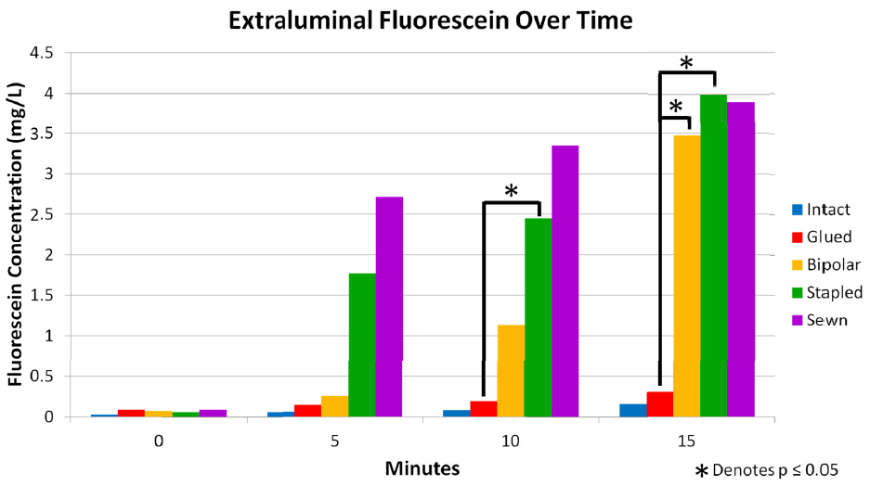
- The inventor validated the prototype stent using an ex vivo swine model and compared fluid and microbial permeability to that of stapled and sewn anastomoses. The invention resulted in dramatically lower permeability of anastomoses.
FIGURE
ADVANTAGES
ADVANTAGES
- Designed to reduce anastomotic leaks and postoperative infections
- Lower anastomosis permeability than established anastomotic techniques
- Minimizes intraluminal collagen exposure
- Maintains good blood supply to healing bowel edges
APPLICATIONS
- Surgery (human and veterinary):
- Acute care/Trauma
- Colorectal
- Esophageal
- Hepatobiliary