

NVC@30 Fireside Chat with 2017 Winner Kyle Swinsky Explores the Journey from Startup to Scale
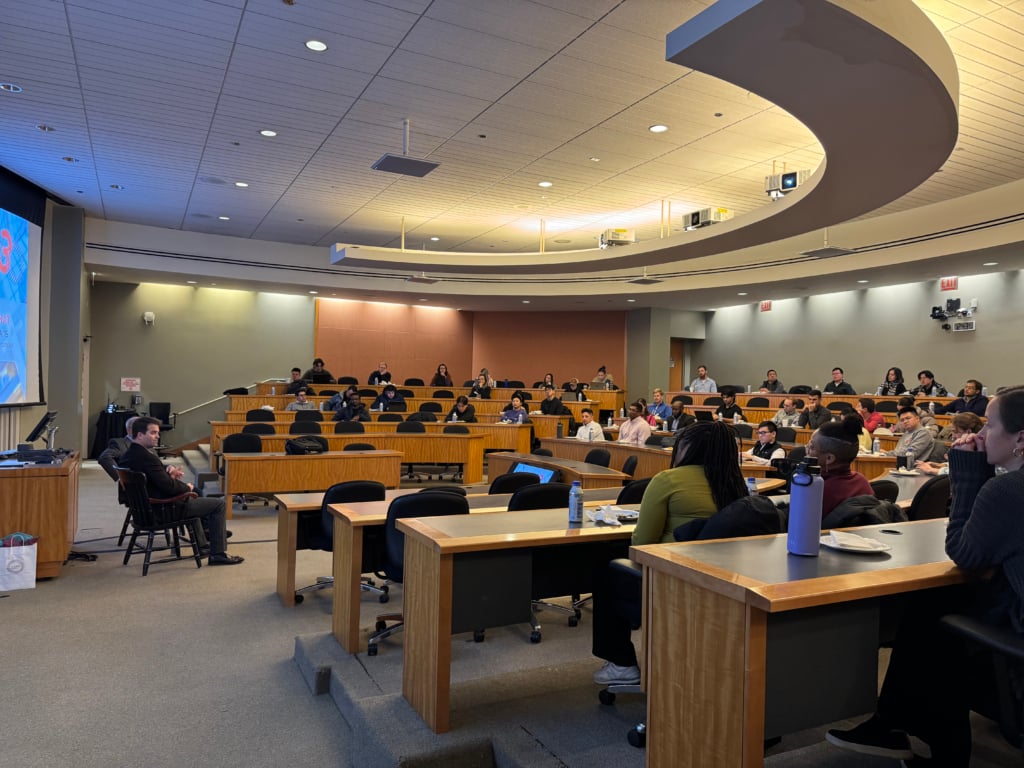
The Polsky Center continued its NVC@30 Fireside Chat series with Kyle Swinsky, MBA ’19, cofounder of AMOpportunities and winner of the 2017 Edward L. Kaplan, ’71 New Venture Challenge (NVC). Moderated by Mark Tebbe, adjunct professor of entrepreneurship at Chicago Booth and entrepreneur in residence at the Polsky Center, the conversation followed Swinsky’s journey from identifying a problem while trying to become a doctor to building a mission-driven company serving thousands of medical students worldwide.
Opening the discussion, Tebbe reflected on the longevity of the New Venture Challenge and the impact those who went through it have had on the program.
“The NVC is built on the shoulders of past participants and winners,” he said. “It’s the reason why the investments have increased over time, because people like you who run successful businesses and demonstrate what is possible.”
Swinsky cofounded AMOpportunities based on his firsthand experience with a systemic gap in medical education. While pursuing a pre-med path, he saw how difficult it was — particularly for international students — to secure clinical rotations required to complete their medical training.
“There were clear issues on both sides,” Swinsky said. “Students needed these experiences to enter the workforce, and doctors had a problem accessing the labor market. We saw these shortages, so we started building internationally.”
When Swinsky arrived at Chicago Booth, he had already started the business and had some early revenue coming in, but he credits the University for helping shape it.
“At Booth, you learn as much from your peers as you do from professors,” he said. “I came in with a concept, but it was the people around me who helped define it. That network became the backbone of the business.”
Swinsky entered the NVC with early revenue and a solid model. Through the NVC, he quickly began revising and updating his plans.
“The NVC breaks down all your assumptions,” he said. “It forces you to test what you believe in front of people who are asking hard questions.”
While validation initially felt like the primary goal, Swinsky now sees the experience differently. 
“At the time, I thought the NVC was about validation,” he said. “Looking back, it was really about relationships and learning when to hold firm to your beliefs and when to open yourself up to advice.”
That balance proved critical, as AMOpportunities won first place in the 2017 NVC, taking home $200,000. Coming out of the competition, Swinsky said the company entered a new phase.
“Before the NVC, it was a great startup — a passion project that made money,” he said. “Afterward, it became a responsibility.”
The company raised its first seed round of $2 million, with its first check coming from the NVC itself.
“There was excitement, and we had to seize the moment,” Swinsky said. “We took everything we learned and started applying it.”
As the company grew, AMOpportunities expanded from a direct-to-student model to working with universities, addressing the same foundational problem through new channels.
“The problem never went away,” Swinsky said. “We just kept solving it in different ways.”
As AMOpportunities grew from five to 25 employees, Swinsky said the challenge shifted from vision to execution.
“That stage is all about mobilization and talent,” he said. “It’s another reason Booth and Polsky matter — the conversations don’t stop after the NVC. We remained in contact with investors, mentors, and peers long after the competition.”
The company remained headquartered in Chicago, intentionally tapping into the Midwest ecosystem while attracting investors from both coasts. Transparency became a hallmark of Swinsky’s leadership. Regular investor updates — an approach he credits to lessons from the NVC — paid off years later when new funding rounds came together with surprising ease.
When the COVID-19 pandemic halted international travel, AMOpportunities faced a defining moment.
“Seventy-five percent of our business was international,” Swinsky said. “And with the pandemic, international travel essentially disappeared.”
The company adapted, launching virtual clinical experiences and expanding access for U.S. students — many of whom now faced the same challenges international students once did.
“Trust is what carried us through,” he said. “We had built it with customers, investors, and our team.”
After more than a decade of growth, AMOpportunities entered a new chapter with a majority investment from a private equity partner. Swinsky transitioned out of the CEO role in 2025 after 13 years leading the company.
“Letting go is emotional,” he said. “It’s validating, but it’s also about long-term responsibility — doing what’s best for the company, your colleagues, customers, and investors.”
Reflecting on his journey, Swinsky shared with students in the audience that entrepreneurship doesn’t get easier — it just changes.
“If you truly believe in the problem, you stick with it,” he said. “And even if things don’t turn out the way you expected, you learn more about yourself than anything else.”
He pointed to people — not product or technology — as the most critical factor.
“Your customers, your team, your investors — those relationships are everything,” he said. “That’s something Booth reinforced again and again.”
Swinsky closed by reflecting on the program that helped launch his company.
“I still have our NVC check in the office,” he said. “It reminds us where we started.”
Today, AMOpportunities has helped more than 25,000 medical students access clinical experiences worldwide — impact that Swinsky says would not have been possible without the Booth and Polsky ecosystem.
“The university network changed everything,” he said. “My Booth education didn’t end when I graduated, and neither did the support.”
The event was part of the NVC@30 Fireside Chat series, celebrating three decades of the Edward L. Kaplan, ’71 New Venture Challenge — one of the nation’s top-ranked accelerator programs. Upcoming events will feature additional NVC alumni founders, each reflecting on how Booth’s entrepreneurial ecosystem helped transform their ideas into industry-changing companies.