

A Highly Efficient Spatial and Temporal Method for Isotopic Separation
SUMMARY
- Present isotope separation methods utilize laser beams, centrifugation, and diffusion to exploit subtle differences in physical properties. However, these methods are relatively inefficient and require multiple successive steps to achieve desired enrichment.
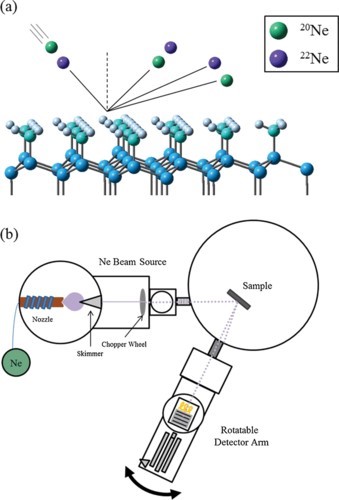
- The angle at which molecules elastically scatter from a crystalline surface is dependent on both the velocity and angle of the incident beam. Based on this, the inventors devised an isotopic separation scheme in which a supersonic beam with a specific velocity and velocity distribution is directed at a crystalline substance. The different isotopes composing the beam scatter at different angles from the crystal surface, which allows for the isotopes to be separated and collected.
- The invention is a system for the highly efficient separation of isotopes below 50AMU based on supersonic beam diffraction. The system consists of an ultra-high vacuum (UHV) scattering apparatus and an adjustable mass spectrometer detector and collector.
- In small scale proof of concept experiments, the inventors evaluated the separation of an isotopic mixture consisting of 20Ne and 22Ne. The method yielded an enrichment ratio of 3.50+/- 0.30 with respect to 22Ne and the measured diffraction pattern of the isotopes matched to the computationally predicted diffraction pattern.
FIGURE
ADVANTAGES
ADVANTAGES
- Improved efficiency
- Isotopes in mixture can be selectively collected
APPLICATIONS
- Compressed gasses
- Life sciences isotopic labeling
- Radiation medicine
PUBLICATIONS
- Nihill, KJ; et al. Separation of isotopes in space and time by gas-surface atomic diffraction. Phys. Rev. Lett. 119, 176001-23 Oct. 2017
- News Article: Lerner, L. UChicago chemists introduce novel method to separate isotopes. UChicago News. 2017 Oct. 23.