Rattan L. Khosa SeedCon 2026: Beyond the Hype
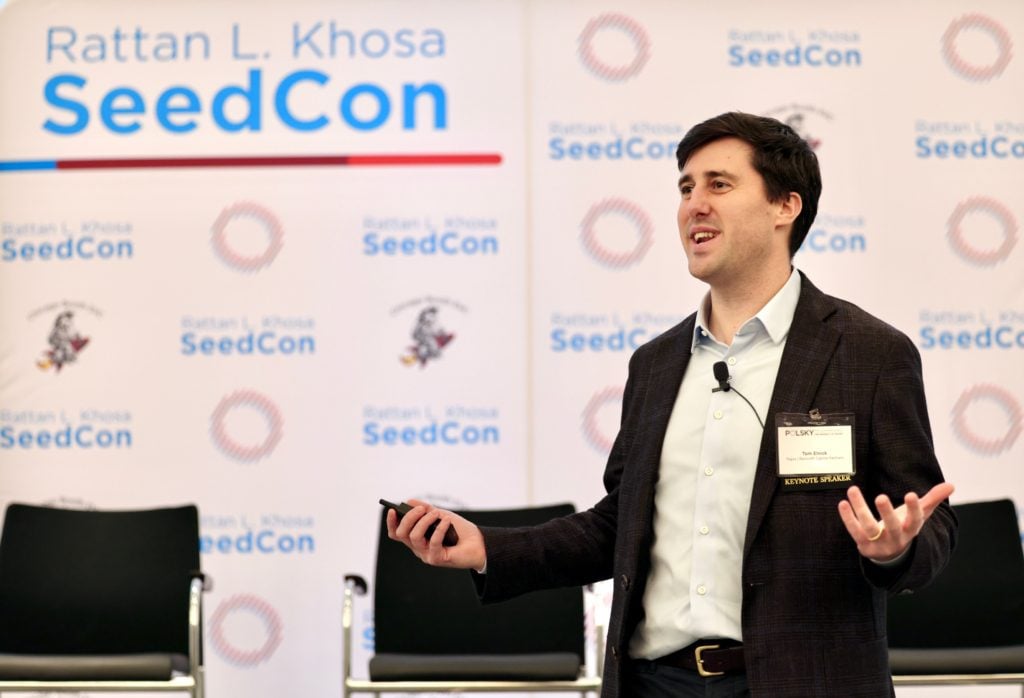
Tom Elnick, former cofounder and co-CEO of Tegus and partner at Bancroft Capital Partners, speaking at SeedCon.
Last week, the Polsky Center for Entrepreneurship and Innovation and Chicago Booth’s Entrepreneurship and Venture Capital (EVC) Group hosted the Rattan L. Khosa SeedCon 2026, the University of Chicago’s flagship entrepreneurship and venture capital conference. Held at the David Rubenstein Forum, the event brought students, entrepreneurs, investors, and leaders from across the startup ecosystem for a day of conversations on what it takes to build enduring companies.
This year’s theme, Beyond the Hype, centered on moving past buzzwords and short-term trends to focus on the fundamentals of entrepreneurship — from resilience and discipline to integrity, sound judgment, and long-term value creation. Through keynote remarks, panel discussions, and fireside conversations, SeedCon challenged attendees to look honestly at the realities of building companies in an increasingly complex and fast-moving environment.
Opening Remarks
The conference opened with remarks from Starr Marcello, MA ’04, MBA ’17, deputy dean for MBA and Master’s Programs at Chicago Booth, special advisor to the provost, and adjunct associate professor of entrepreneurship, alongside Rattan L. Khosa, ’79, founder and CEO of AMSYSCO Inc.
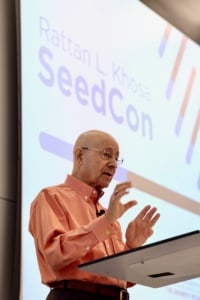
Rattan L. Khosa providing opening remarks.
Marcello underscored SeedCon’s long-standing role as a cornerstone of entrepreneurship at Booth and a meeting point for the broader Chicago startup community.
“SeedCon is a long tradition at Booth — our premier entrepreneurship and venture capital conference,” Marcello said. “It serves as a moment for the Chicago Booth community to come together, but also as a beacon for entrepreneurship across the city of Chicago.”
She introduced this year’s theme, Beyond the Hype, noting that the day’s discussions would focus on the lived realities of entrepreneurship rather than surface-level narratives.
“Through today’s panels, you’ll hear stories of creativity, resiliency, and strength — but also honesty about the challenges of building a company,” Marcello said. “We hope you leave today a little wiser about what it takes to be an entrepreneur.”
Khosa followed with reflections on his own entrepreneurial journey and the principles that have guided AMSYSCO for more than four decades. He shared how professional setbacks early in his career ultimately pushed him to start a company — not out of ambition, but necessity.
“I didn’t start a business because I had a brilliant idea or because I thought I was going to make a lot of money,” Khosa said. “I started out of desperation.”
Rather than chasing rapid growth or outside capital, Khosa emphasized building a business grounded in quality, service, and integrity, even when those choices came at a higher cost.
“When you make a quality product with great service, it costs money,” he said. “But there is no other option. If you choose cheap everything, you won’t last.”
After failing to raise funding, Khosa launched AMSYSCO from his basement with no external financing. Now in its 45th year, the company has remained profitable every year and has never taken on debt — an outcome Khosa attributed to reinvesting in the business and prioritizing people.
“The substance of the business comes from our employees,” he said. “In my company, employees come first — then customers, then suppliers.”
During a Q&A session, Khosa reflected on how his perspective evolved over time, noting that early failures shaped a more disciplined approach to growth. He also offered a measured view on artificial intelligence, underscoring the enduring importance of judgment and intuition.
“In life and business, you make many decisions based on gut feeling,” Khosa said. “The question is whether AI will ever truly be able to do that.”
Healthcare: Innovation to Adoption — Delivering Real Patient Outcomes
The Healthcare: Innovation to Adoption panel focused on how healthcare startups can move beyond promising ideas to solutions that deliver real value for patients and providers.
Moderated by Brian Coe, HD ’87, MBA ’99, CEO of Belay Diagnostics, the discussion featured Anthony Alepra of Techstars and the Northwestern Medicine Healthcare Accelerator; David Buchanan, MD ’96, CEO and cofounder of Town Square Health; and Hailey Lefkofsky, senior director, Neurology and Psychiatry at Tempus.
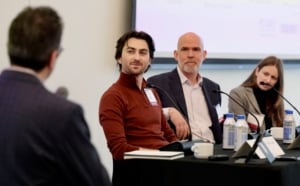
The Healthcare: Innovation to Adoption panel.
Coe opened the conversation by framing the moment healthcare finds itself in today — one defined by advances in biotech, data, and artificial intelligence, alongside growing hype and investment.
“With everything happening in biotech and information, it’s hard to fathom how different things were just a decade ago,” Coe said, before challenging panelists to distinguish between where the excitement around AI is warranted and where it may be overstated.
Lefkofsky emphasized that AI delivers the most impact when it solves tangible, everyday problems rather than chasing novelty. She pointed to physician-facing tools, such as AI-powered clinical scribes, as examples of technologies that gained rapid adoption because they address real pain points.
“What takes off is what advances your everyday work,” Lefkofsky said. “AI scribes solve real problems for physicians who are bogged down by administrative tasks. That’s why adoption happened so quickly.”
Alepra echoed that sentiment, cautioning founders against positioning AI as the product rather than as an enabler of meaningful solutions.
“It’s easy and tempting to sell ‘AI’ because that’s where the attention and capital are,” Alepra said. “But the companies that succeed long term are the ones executing on real business problems. If AI happens to be the best technology to solve that problem, great — but that shouldn’t be the starting point.”
Buchanan reinforced the importance of domain expertise and complementary founding teams, particularly in an industry as complex as healthcare.
“If you don’t have someone who understands the inside of your customer’s organization, it becomes very difficult to communicate value,” Buchanan said. “That knowledge gap can stop a company before it ever really starts.”
Throughout the discussion, panelists repeatedly returned to the importance of focus. Lefkofsky advised founders to resist the urge to build broad, all-encompassing platforms early on.
“Do one thing really well,” she said. “Find a problem you’re uniquely positioned to solve and a customer who truly cares about that solution. When companies try to do too many things, it signals that they’re spread too thin.”
The conversation also offered guidance for students and early-career professionals interested in healthcare entrepreneurship. Alepra noted that success at the early stage often comes down to deep customer understanding and the ability to connect solutions directly to value.
“The people who do well are the ones who truly understand their customers, meet them where they are, and can clearly connect the dots from problem to outcome,” Alepra said.
Closing the panel, Coe reminded attendees that at the heart of healthcare entrepreneurship is purpose.
“Solving customer needs is the foundation of it all,” Coe said. “But you also have to look inward — what problems do you care about enough to throw your heart and soul into? Where you’re going and who you’re taking with you matter just as much.”
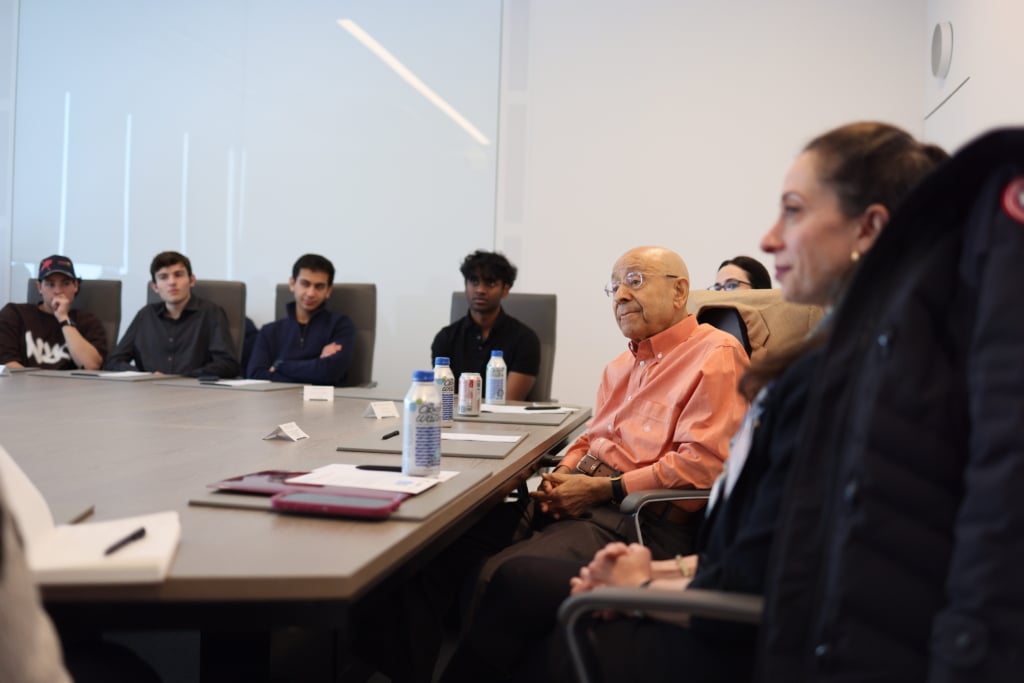
Khosa speaking with students.
Enterprise AI: Making AI Actually Work
The Enterprise AI panel explored what it really takes to move artificial intelligence from experimentation to meaningful adoption inside large organizations. Moderated by Allison Weil Lechnir, MBA ’17, MPP ’17, partner at Hyde Park Venture Partners, the discussion featured Anish Aggarwal, partner at Lightbank; Steve Hind, cofounder and CEO of Lorikeet; and Jack Piunti, go-to-market lead at ElevenLabs.
Panelists emphasized that while enterprise AI sales share similarities with traditional SaaS, the stakes — and complexity — are significantly higher. Piunti noted that legal, compliance, and security teams are now involved from the very first conversations, requiring founders and go-to-market teams to spend more time educating internal champions and navigating unfamiliar procurement processes.
“There are more stakeholders involved much earlier,” Piunti said. “A lot of enterprise teams are still learning how to evaluate generative AI, so education is a big part of the sale.”
Hind added that selling enterprise AI often looks less like software sales and more like hands-on consulting, requiring teams that can deeply understand customer workflows and problem-solve alongside them.
“You’re selling more than just a product, you need to be able to understand the customer deeply and be able to get creative on solutions to their problems,” he said.
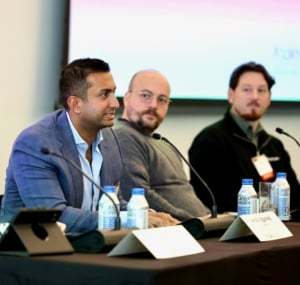
The Enterprise AI panel.
From an investor perspective, Aggarwal stressed that the fundamentals of great software companies still apply. Usage, retention, and evidence of real stickiness remain the strongest signals of long-term value.
“The principles that make software business models durable still guide how we think about AI startups,” Aggarwal said.
When discussing real-world adoption, panelists pointed to customer support, content localization, training, and gaming as areas where AI is already delivering value beyond innovation teams. However, trust remains a major barrier. Enterprises are willing to test AI, Hind noted, but far less willing to rely on it without safeguards.
“You can’t promise it will never be wrong,” Hind said. “What you can do is prove it performs better than existing processes.”
The panel also highlighted data integration as one of the biggest obstacles to scaling enterprise AI. Without clean, centralized data, even the most advanced models struggle to deliver impact — forcing many startups to embed deeply with customers before transformation is possible.
Closing the discussion, panelists mostly agreed that there will be no single “winning” AI model at the enterprise level. Instead, success will favor companies that combine strong technology with thoughtful deployment, clear ROI, and organizational alignment.
As Piunti summed up, “The models are capable — the real challenge is how you deploy them.”
Deep Tech: Turning Breakthroughs Into Sustainable Businesses
The Deep Tech panel examined what it takes to turn breakthrough science into companies, recognizing that deep tech ventures operate on longer timelines, face greater technical risk, and require a fundamentally different approach than traditional software startups.
Moderated by Karthee Madasamy, MBA ’06, founding managing partner at MFV Partners, the panel featured Nathan Arnold, cofounder and CEO of Photon Queue; Keith Crandell, MBA ’88, cofounder and managing director of ARCH Venture Partners; Nii Dodoo-Amoo, managing partner at AquaRock Capital; and Kanav Setia, cofounder and CEO of qBraid.
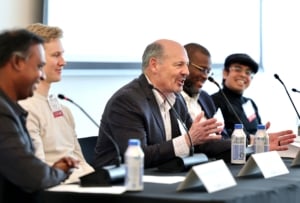
The Deep Tech panel.
Madasamy opened by reframing “deep tech” as a return to venture capital’s roots — IP-led innovation that powered the early days of Silicon Valley. While the term may be new, he noted, the category reflects a focus on foundational technologies with the potential to reshape entire industries.
Crandell emphasized that deep tech investing is about tackling problems that matter, often through sustained technological advancement. Success, he noted, depends on disciplined execution, strong intellectual property, and a deliberate approach to reducing technical risk over time.
“It’s not about being a mile wide and an inch deep,” Crandell said. “It’s about focus and systematically reducing risk.”
Arnold highlighted how traction can be a critical indicator of commercial viability. He shared that interest from those in the industry during his PhD research provided a clear signal that his work could become a company, reinforcing the importance of building technology that others actively want.
Panelists also discussed how deep tech founding teams differ from traditional startup archetypes. Setia noted that deep technical conviction often matters more than early business polish, particularly when the underlying technology itself is still being proven.
“If the value proposition is still under development, you’re first proving the technology — then building the business around it,” Setia said.
From an investor perspective, Dodoo-Amoo highlighted grit, low ego, and commercial awareness as defining traits of successful deep tech founders. While many startups emerge from academic settings, he stressed the importance of founders who are willing to learn, seek advice, and stay committed through long development cycles.
Looking ahead, panelists pointed to robotics, industrial automation, advanced manufacturing, and semiconductors as areas of growing opportunity, driven by shifting global supply chains and the limits of continued software-driven growth. Across the discussion, the message was clear: while deep tech may take longer to mature, its potential to create lasting economic and societal impact remains unmatched.
Closing Keynote: Building What Lasts
The conference closed with a keynote from Tom Elnick, former cofounder and co-CEO of Tegus and partner at Bancroft Capital Partners, who offered a candid reflection on the emotional reality of entrepreneurship and the principles that ultimately turned Tegus into a multi-billion-dollar company.
Elnick began by recounting the early days of Tegus, when the excitement of calling himself a founder eventually gave way to doubt. After months of zero revenue, limited traction, and uncertainty, he found himself questioning whether he had made the right choice — a moment solidified by a blunt comment from his mother.
“There’s a fine line between entrepreneurship and unemployment,” he recalls her saying. “It’s starting to look like you’re unemployed.”
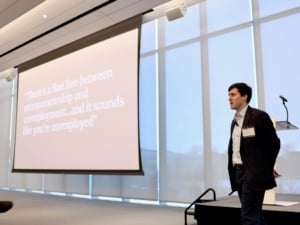
Elnick providing closing remarks.
While said in jest, that comment led to a fundamental reset. Elnick started rethinking his moves, figuring that since nothing had happened for 18 months, he might as well try a different way. He continued by outlining three decisions that transformed Tegus’s trajectory, beginning with flipping the traditional startup playbook.
“Sell first, then design, then build,” Elnick said, explaining that Tegus only moved forward once customers were willing to sign contracts and pay — even for a beta product. Asking whether customers would actually buy, rather than whether they liked the idea, proved to be the turning point.
The second shift was narrowing focus. After initially onboarding a wide range of customers across industries, Tegus refunded most of them to concentrate on a small, highly specific customer base.
“Trying to do everything invites mediocrity,” Elnick said. “Narrowing focus lets you build something people love so much they won’t give it up.”
Finally, Elnick emphasized the importance of long-term thinking over short-term wins. Rather than building for a quick exit, Tegus committed to becoming a multi-decade business — prioritizing people, culture, and product above all else.
“We wanted customers who would say, ‘Over my dead body,’ if someone tried to take the product away,” he said.
Beyond company-building tactics, Elnick encouraged attendees to think more broadly about careers and life. He urged students to choose the “right elevator” — environments that compound learning and growth — and to work for managers and organizations whose values align with their own.
He closed with a reflection that echoed the conference’s broader theme of moving beyond hype, reminding the audience that success is not just about building companies, but about building a life worth living.
“It’s one thing to build a business,” Elnick said. “But you should also ask whether the life you’re building alongside it is the one you want.”